
EXCLUSIVE: The translation error that made us "gods" (and the administrative headache it caused)

1530s
Official history, the kind so often written in the sensationalist ink of the Black Legend, has sold us an irresistible blockbuster: when the Spaniards landed in the New World, the natives, dazzled by the armor, the horses and the arquebuses, fell to their knees believing that Hernán Cortés was the feathered serpent Quetzalcoatl and Francisco Pizarro the creator Viracocha. A perfect tale of European superiority and indigenous naïveté.
But here at the Agency of the Indies we are in the habit of auditing the receipts. And the logistical and linguistic records of the 16th century tell us a very different story. The conquistadors' supposed "apotheosis" was not an act of magical submission, but a colossal bug in the linguistic hardware of the age, a translation error that the Spanish imperial administration had to correct with dictionaries, universities and royal decrees.
The "Linguistic Hardware" of Malinche and Felipillo
Picture the scene: a handful of bearded fellows arrive in floating houses from a place that appears on no local map. Cortés's interpreter, doña Marina (la Malinche), has to process this unprecedented input and translate it from Spanish into Maya, and from there into Nahuatl. To describe these strangers, the Nahuas used the word teotl (plural teules). The Spaniards, running their monotheistic operating system, automatically rendered this as "gods."
But teotl did not mean "God" in the Judeo-Christian sense of an omnipotent, bearded creator seated on a cloud. In the Mesoamerican conceptual network, teotl was a spectrum of power. It could refer to a deity, yes, but also to a priest, a sorcerer, a sacred object, or simply to something "fine, exotic and powerful." Calling the Spaniards teules was the 16th-century equivalent of saying "these guys are VIPs with cutting-edge technology," not "praise be to the Most High."
The same thing happened in the Andes. The translator Felipillo called Pizarro's troops viracochas. The Spanish chroniclers assumed the Incas were mistaking them for their creator god. Yet viracocha translates literally as "sea foam" or "lake grease." It was a descriptive and logical term for strangers who had, quite literally, just emerged from the foam of the ocean. In fact, King Atahualpa's envoys quickly audited these alleged "gods" and reported that there was nothing divine about them: they needed to drink water from canteens (rather than conjuring springs in their wake), they plundered gold and they mistreated the population. "They are thieves; let us burn them while they sleep" was the Inca intelligence report.
The Friars' Audit: Disabling VIP Status
When the first wave of Franciscan missionaries arrived in New Spain in 1524, they ran into a theological and administrative problem of the first order. Friar Toribio de Benavente, known as Motolinía, realized that the natives were still calling the conquistadors teules. To install the new Catholic operating system, this error had to be purged.
Motolinía and his colleagues launched a software-update campaign: they explained to the natives that there was only one God and that the men in armor were mere mortals called "Spaniards." Curiously, those who complained most about this correction were not the natives, but the Spanish soldiers themselves. As Motolinía himself recounts, some conquistadors were outraged at losing their divine status. The friar branded them "fools" for usurping a title that belonged solely to celestial upper management.
Even demography dismantles the myth of white deification. The Florentine Codex, that monumental bilingual encyclopedia compiled by Friar Bernardino de Sahagún and his indigenous students at the College of Santa Cruz de Tlatelolco (the first institution of higher education in the Americas), records that the African slaves and servants who accompanied the Spaniards were also given the title of teules. They were catalogued as "dirty gods" or "stained gods." Divinity, in the indigenous context, was not a matter of being of the white race, but of otherness and power.

The Protocol of the Hispanic World: Laws, Not Myths
While centuries later the British Empire would delight in letting its officers be worshipped as deities in India (with altars where gin and cigars were offered to them, as to the infamous Captain Pole or the wrathful John Nicholson), the Spanish Crown saw deification as a legal liability.
If the Spaniards were gods and the natives incorrigible idolaters, how could the evangelization and integration of these territories as overseas provinces be justified? The Hispanic world was not after worshippers; it was after subjects with full rights. This debate culminated in the famous Valladolid Controversy (1550), where it was determined that the natives were rational human beings, possessors of a soul and therefore subject to the protection of the New Laws of 1542, which prohibited their enslavement.
The myth of the "White Gods" was, in reality, a construction after the fact. It was the Europeans of the 18th and 19th centuries, obsessed with phrenology and scientific racism, who inflated these anecdotes of the conquest to justify modern imperialism. They wanted to believe their supremacy was so self-evident that "primitive" cultures recognized it instinctively as divine.
But the archives of the Indies do not lie. We were not gods come down from heaven. We were explorers, administrators, translators and legislators grappling with the greatest cultural clash in human history. And we managed it not with thunder and lightning, but with grammars, universities and an intense legal debate. Because in the Spanish Empire, even to be a God you had to fill out the right form in triplicate.
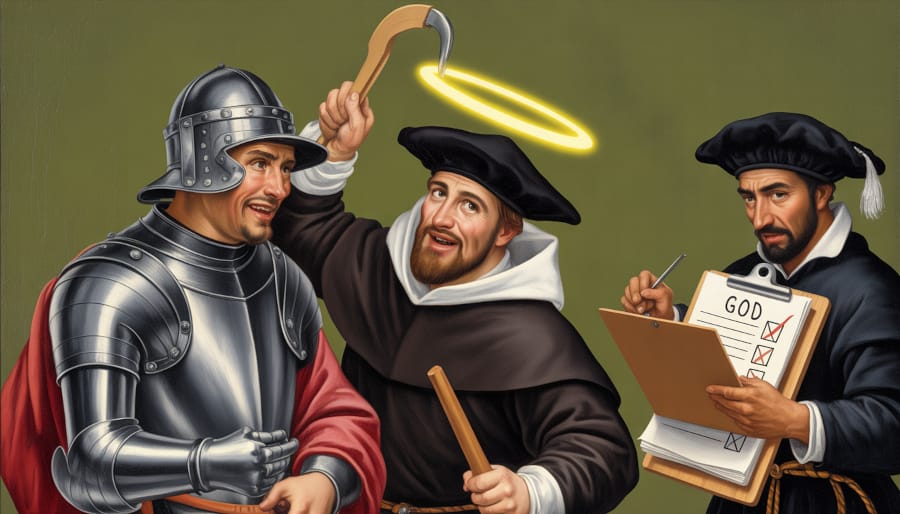
REALITY UPDATE: THE 'MORTAL' PATCH IS NOW AVAILABLE!
Do your neighbors burn incense for you when all you want is to get paid for your encomienda? Tired of being called 'Sea Foam' when what you really crave is a ration of jerky? Install the Dictionary of the Indies 1.0. Disable the 'Divine VIP mode' bug and keep the friars from branding you a heretic for usurping the functions of celestial upper management. Go from myth to soul-bearing subject for a laughable price!
* Donation for the Pultsar News project



Comentarios ()