
ROME BURNS! Nine days of fire lay waste to the heart of the Empire: the people sleep among the tombs, and the name of the arsonist is already running through the streets
ROME, ESQUILINE DISTRICT, DAWN OF THE NINTH DAY | LIVIA TACITA | 🦅 ROME SPQR · CHRONICLES
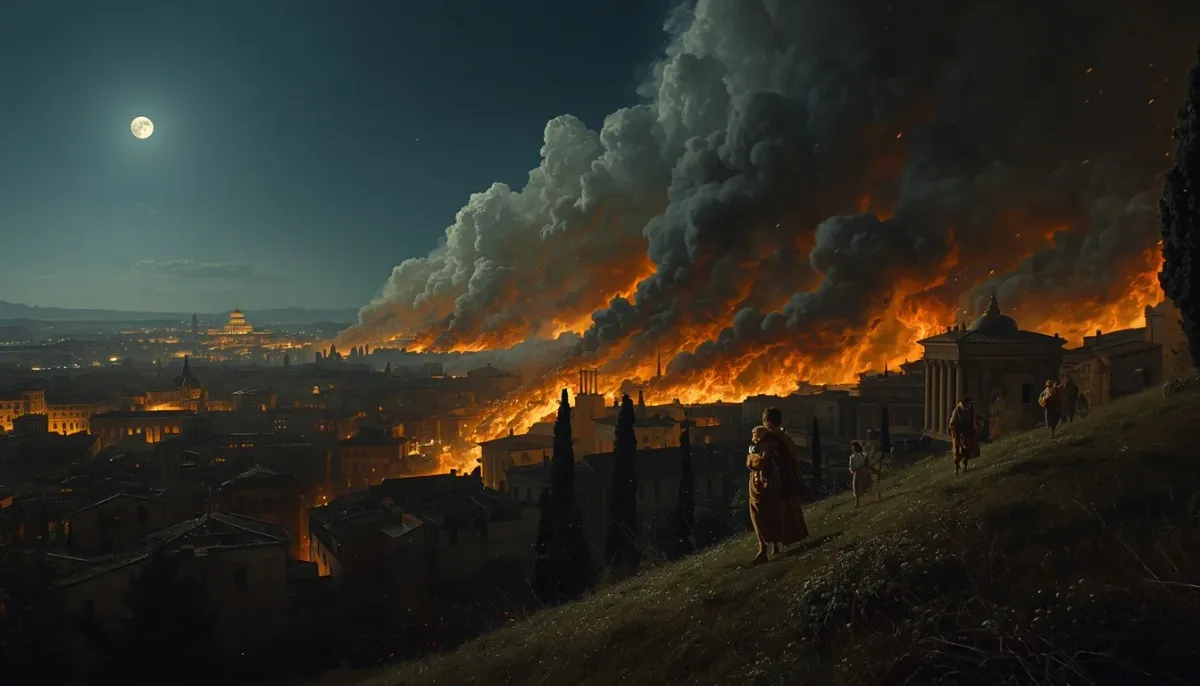
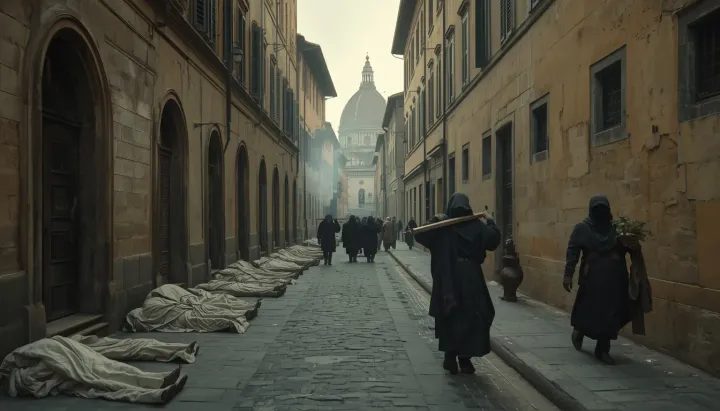
The Rome that burned no longer stands. From the heights of the Esquiline, where I write this dispatch with my toga still reeking of ash, one sees the valley of the Circus Maximus turned into a black field of smoking beams and beheaded walls. Where there were temples four centuries old, there are now slabs of charred stone. Where there were entire blocks of dwellings, there is bare lot. Of the fourteen regions into which the divine Augustus divided the City, the praetors taking record this morning can note down only four intact. Three have vanished completely: of them there remain only a few stretches of wall half thrown down and scorched. The other seven stand somewhere between the one state and the other.
It has been nine days. And it still smokes.
Chronicle: how it caught, and which way it ran
The fire began the night of the 18th to the 19th of July, under a full moon, at the end of the Circus Maximus that borders the Palatine and the Caelian. It did not catch in a temple or in a palace: it caught, as nearly every fire in this City catches, in a row of merchant shops —those crammed with goods that burn of their own accord: oil, cloth, firewood, tow. What on any other night would have been a neighbourhood scare, that night found the wind.
Tacitus, who is gathering testimonies for his account of the events, sums it up with a prudence that this correspondent endorses word for word:
“Sequitur clades, forte an dolo principis incertum” — «There followed a disaster, whether by chance or by the treachery of the emperor is uncertain (for authors hand down both interpretations), though graver and more dreadful than all that have befallen the City through the violence of the flames.»
Mark that sentence well, for it will be the frontier between history and slander for centuries to come: it is uncertain. What is certain is the mechanics. The fire, born among the shops, «gathered strength at once and, spread by the action of the wind through shops stocked with combustible goods, ran the whole length of the Circus». From there it climbed the slopes and poured down the valleys. There were, Tacitus writes, no mansions ringed by walls nor temples girdled by an enclosure to serve as firebreaks: old Rome, the Rome of narrow and crooked streets, burned for being exactly what it was.
Engineering: why a city of a million souls could not put out a fire
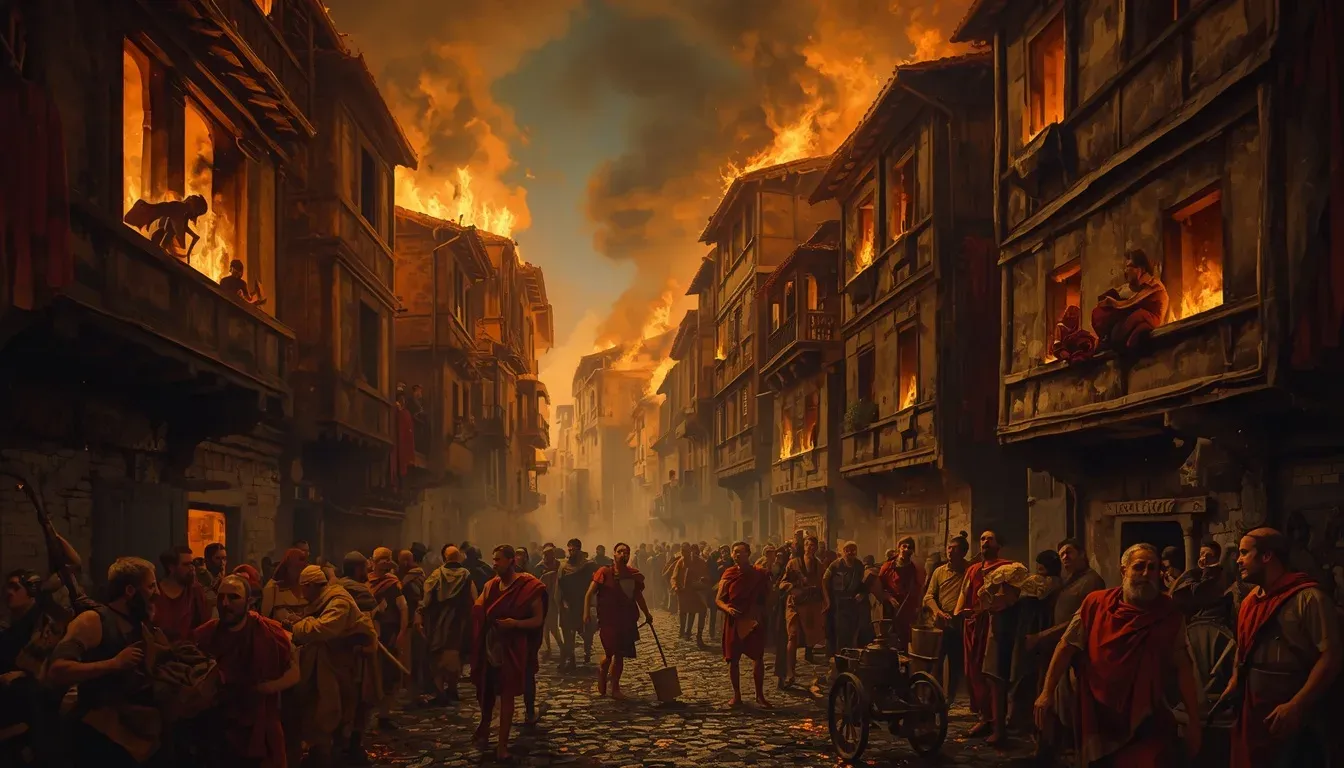
Readers in the provinces will find it hard to grasp, so it bears explaining. Rome is the greatest city in the world and the worst prepared to burn with dignity. The plebs do not live in domus of courtyard and marble: they live stacked in insulae, blocks of three, four and five storeys raised on timber framing, with wattle partitions daubed in mud and beams dried out by the summers. They are built one against the next, without a hand's breadth of air between façade and façade, in alleys where no cart can pass. One burns, ten burn.
Against that, the City has seven cohorts of vigiles —the night watchmen who serve as patrol and as fire brigade— armed with buckets, soaked blankets, hooks for pulling down, and hand-pumps. They will do for an overturned brazier. They will not do for a firestorm driven by the July wind down the length of a valley. The one weapon that truly works against a fire like this is demolition: to open a void ahead of the flames so they have nothing to bite. And that, in the end, was what stopped it.
«At last, on the sixth day, an end was put to the fire at the foot of the Esquiline, after an enormous quantity of buildings had been pulled down so that the open ground and, so to speak, the bare sky might check that endless violence.» (Tacitus)
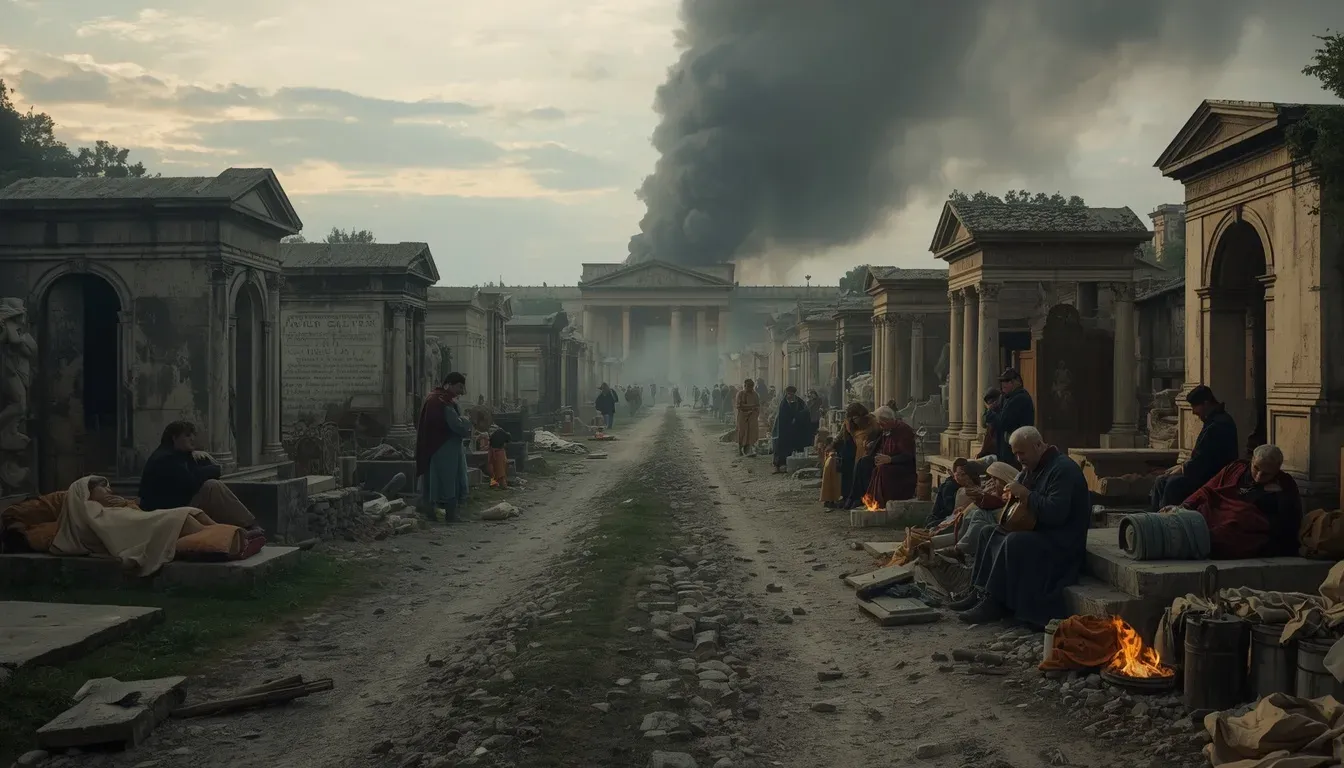
Six days to tame it at the cost of tearing down half the city. Suetonius, less merciful, rounds it off: «six days and seven nights», and adds the detail that during them the people «had no other refuge than the monuments and the tombs». I have seen it with my own eyes: whole families camped among the tombs of the Appian Way, sleeping over the names of their dead because it was the only roof that did not burn.
The Gossip: where was the emperor, and what is this about the lyre?
Here is where an honest chronicle must tread carefully, because here is where the street and the truth part ways.
When the fire caught, Nero was not in Rome: he was at his villa in Antium, a day's journey down the coast. He returned —Tacitus tells us— when the flames already threatened the palace and the Gardens of Maecenas. And on his return he took measures that any fair chronicler must record: he threw open to the people the Field of Mars and his own gardens, raised emergency sheds for those left with nothing, had provisions brought from Ostia and the neighbouring towns, and lowered the price of grain. All of that is true and all of that was popular.
And all of that —Tacitus writes with a devastating dryness— «fell on deaf ears». Why? Because of a single sentence already passing from mouth to mouth before the ashes had cooled:
«A rumour had spread that at the very moment the City was in flames he had gone up onto a stage in his own house and sung of the fall of Troy, comparing the present calamities with the catastrophes of the past.»
Suetonius takes it for fact and dresses it in stagecraft: that Nero watched the fire «from the top of the tower of Maecenas, delighted, as he said, with the beauty of the flame, and dressed in stage costume sang the sack of Troy the while».
This correspondent had best be plain with her readers, for she draws her pay from Pultsar and not from the Palatine: no one has been able to confirm the scene of the lyre. Tacitus records it as rumour —«a rumour had spread»—, not as fact. Even those who repeat it disagree on the stage: some say he sang in the palace, others on the rooftop, others in the tower of the Gardens of Maecenas. When three witnesses agree not even on the where, the prudent course is to shelve the what. But there are rumours that kill more surely than fire, and this one is already out of control: the artist-emperor, the lyre-player rehearsing his craft while his capital chars, is too rounded a portrait for the street to give it up.
Politics: the most expensive building lot in the world
And here, readers, is the part the rumour grasps without anyone having to explain it. Because the question that truly matters is not whether Nero sang, but this other one: whom does an empty lot benefit?
The fire ravaged with particular fury the valley between the Palatine, the Caelian and the Oppian: precisely the most coveted ground on the planet. And on those ashes —nowhere else— Nero has already begun to raise what the City calls, under its breath, the Domus Aurea, the House of Gold. Tacitus describes it without need of venomous adjectives, merely by listing:
«Nero turned the ruin of his country to account and built himself a house in which the gems and the gold […] caused less wonder than the open fields and pools, with woods on one side, open spaces and lovely vistas on the other, after the manner of sparsely settled country.»
A palace with an artificial lake, private woods and open countryside. In the centre of the greatest city in the world, where the ground is paid for by weight in blood, the emperor has allowed himself the luxury of open country. Suetonius tells us that in the vestibule there will rise a bronze colossus of Nero himself one hundred and twenty feet high. And there is a detail the plebs of the Subura repeat through clenched teeth: the second wave of the fire, the one that flared up again when it was given up for beaten and burned for three more days, «had broken out from an estate of Tigellinus» —the praetorian prefect, the emperor's trusted man, a former trainer of racehorses raised to the armed arm of the regime.
This correspondent makes no accusation. Neither did Tacitus accuse. But we record what he recorded: that the fire cleared precisely the ground that power needed, and flared up again precisely from the property of power's own man. Let the reader do the sums; we only set the numbers in a row.
Feature: who has been made to pay for the rumour
An emperor under suspicion of having burned his own capital needs, urgently, another culprit. And Nero has found one.
«To do away with such a rumour, Nero produced as culprits and punished with the most refined penalties those whom the crowd hated for their depravities and called Christians. The man who gave them this name, Christ, had been condemned to death during the reign of Tiberius by the procurator Pontius Pilate.» (Tacitus, Annals)
They are a small sect, newly arrived from Judaea, looked upon with suspicion for being foreign and for being secretive. The official charge is no longer the fire —which would be costly to prove— but something more convenient and more vague: «hatred of the human race». They first arrested those who confessed to the cult; then, informed on by these, a multitude. And what came after this correspondent writes with a steady hand though her stomach does not follow, because it happened, and to keep silent about it would be to be an accomplice of the man who ordered it:
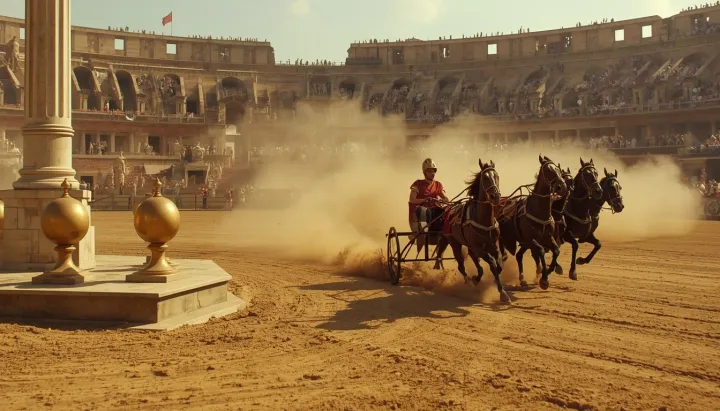
«As they died they were made objects of mockery: covered with the skins of wild beasts they perished torn to pieces by dogs, or were nailed to crosses, or were made ready to be burned and, when daylight failed, were set alight to serve as nocturnal illumination. Nero had offered his gardens for the spectacle and besides was putting on games in the circus, dressed as a charioteer and mingling with the plebs or mounted on a chariot.»
Read it again: human torches to light a garden party, and the emperor strolling among them disguised as a charioteer, saluting the crowd. And then something happened that not even Tacitus himself —who feels not the slightest sympathy for the sect— could refrain from noting: the people, who hated them, began to pity them. Because they understood that they were dying not for justice nor for the public good, but «to glut the cruelty of one man».
That is the price of a badly chosen scapegoat: that the victim ends up cleaner than the executioner.
Closing: what remains when the ash grows cold
To this correspondent, who has covered the nine days from the Esquiline with no desk but a wax tablet and her knee for a table, it falls to close with the only thing the chronicle can offer when the facts are too great: a reckoning.
Four regions standing. Three wiped off the map. Seven half gone. Temples of the kings of Rome, spoils of the Punic Wars, everything that «antiquity had left of curious and worthy of memory» —in Suetonius's words—, gone up in smoke. A persecuted sect that has won in a single night more martyrs than converts in a decade. A palace of gold rising over the lot of the dead. And a sentence of five words, forte an dolo principis incertum, that history will never be able to close.
Rome will rebuild. It always does: with wider streets this time, with porticoes of stone, with ordinances against timber. But there is one thing the new marble will not cover over, and it is the question being asked this morning in low voices, among the tombs of the Appian Way, by those who lost everything: if the City burned by accident, why is the only one who has come out ahead already sleeping in a palace with a lake?
I do not have the answer. Neither did Tacitus. But the question, readers, no firebreak puts out.
— Livia Tacita, from the Esquiline district, Rome.
Mackerel Garum — Salting Company of Nova Carthago
Has the night left a bad taste in your mouth?
The most prized fish sauce of the western Mediterranean, fermented under the Baetican sun in vats by the Pillars of Hercules. A single drop turns a refugee's gruel into a senator's supper. It withstands transport in a sealed amphora, nights in the open, and the most stifling Julys: when everything else spoils, the garum holds. Purveyors to the finest tables of the Palatine that are still standing.
* Donation to the Pultsar News project

Comentarios ()