
SEVEN CHARIOTS AT OLYMPIA! — Alcibiades wins the great race without touching the reins, and takes first, second and fourth
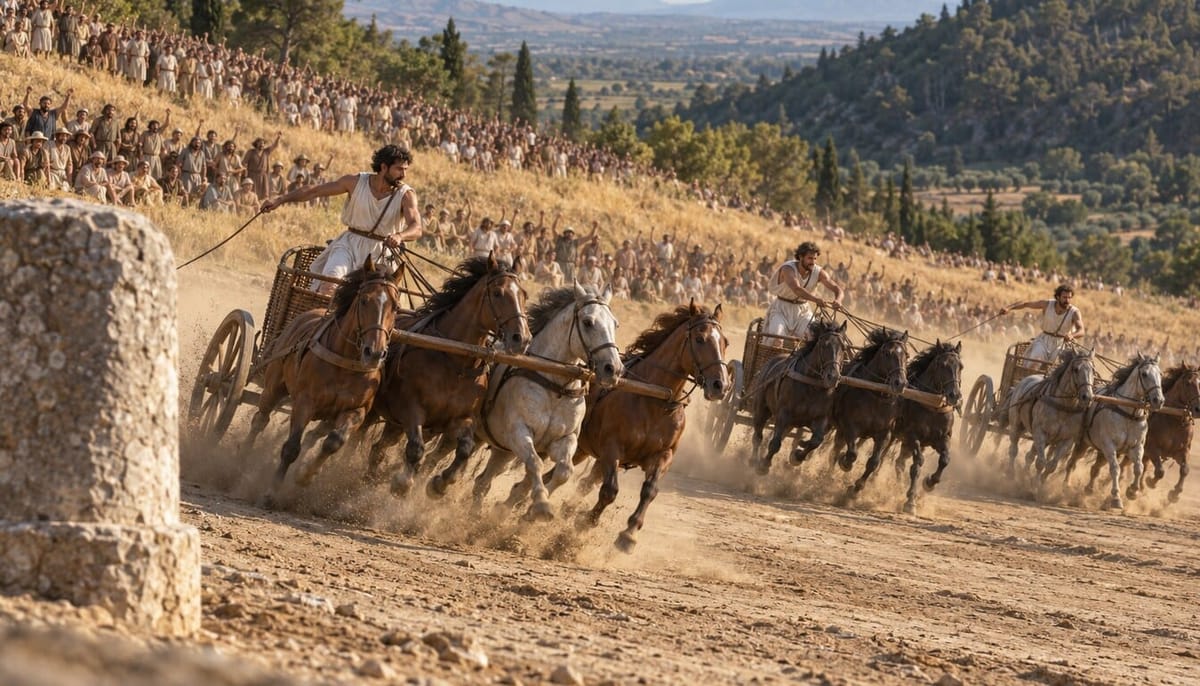
Olympia, Alpheus valley. The dust has not yet settled on the hippodrome when the herald raises his arm, and the earth bank where we have been packed in since dawn goes quiet. “Alcibiades, son of Clinias, of Athens.” Winner of the four-horse chariot race of the ninety-first Olympiad. The applause has barely started when the herald takes another breath: second place, Alcibiades, son of Clinias, of Athens.
Third goes to someone else. Fourth is his again.
Until today, the richest men in Greece would happily ruin themselves to enter a single chariot at Olympia, and dine out on it for the rest of their lives. This Athenian in his thirties, with his carefully kept long hair and his purple cloak, has entered seven. Seven four-horse teams, twenty-eight animals picked one by one, paid for out of his own pocket. No private citizen has ever done it. And he has won.
Sport: the man who pays wins
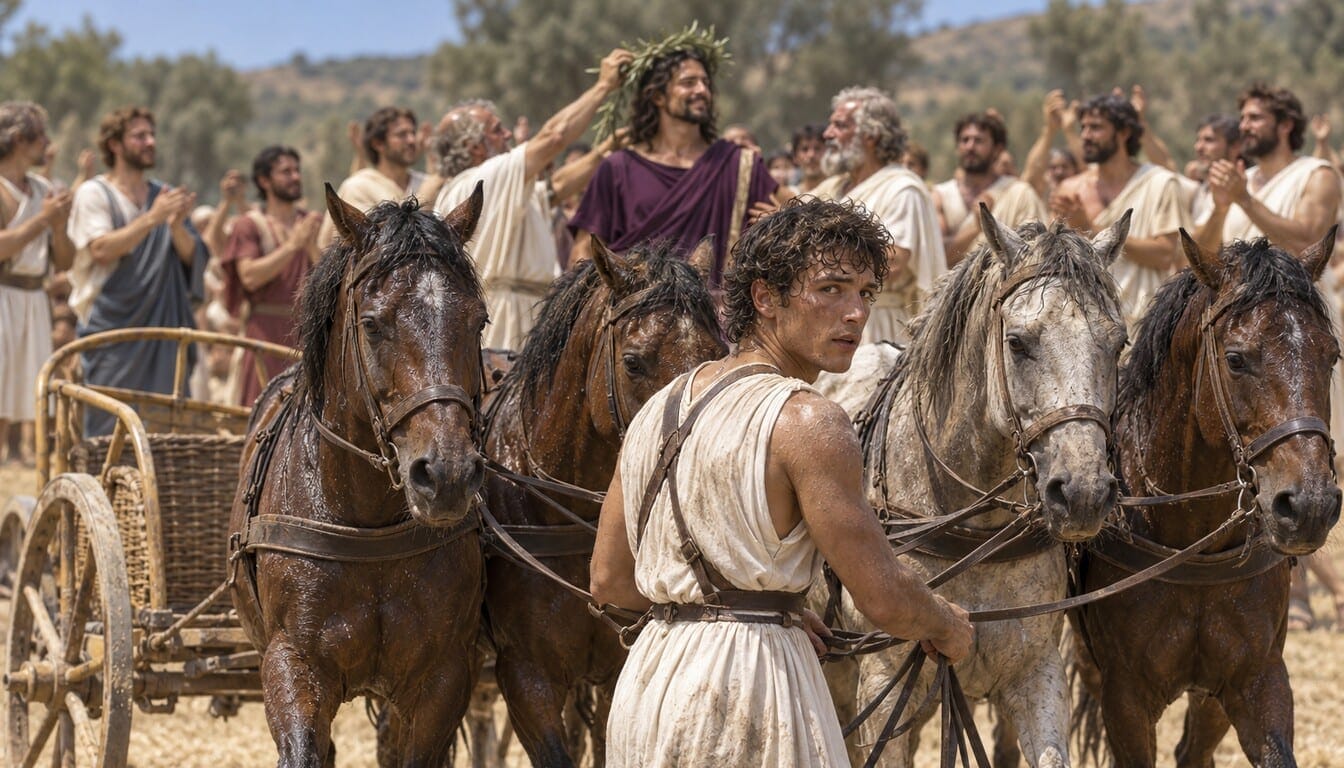
A word for readers from far away, because it isn’t obvious from the stands: in the chariot race at Olympia the winner is not the man who drives. It is the man who owns the horses. The charioteer, that young man in the long white tunic who has just done twelve laps of the hippodrome standing on a light car, reins in his fists and his heart in his mouth at every turn, is not in the proclamation. The herald doesn’t say his name. Nobody will cast it in bronze.
And twelve laps are no stroll. At one of the turns stands the Taraxippus, the “horse-scarer”, a round altar the animals fear like a ghost, and nobody knows why. That is where they rear, where the teams tangle, and where more than one hopeful’s race ended this morning, axles snapped and charioteers dragged through the sand. Alcibiades’ teams came through clean, and not by luck: his horses are the best money can buy in Greece.
“I did the twelve laps,” puffs one of his charioteers as he leads the horses down to the river, dust up to his eyelashes. “The crown is his. That’s how it works.”
There’s no resentment in it. He says it the way you’d mention the weather.
At the end of the Games, as custom requires, a boy whose father and mother are both alive will cut sprigs from the sacred olive by the temple of Zeus with a golden sickle. Two crowns will be woven for Alcibiades’ head. Not a leaf will go to the man who risked his neck at the Taraxippus.
Business: twenty-eight horses and a borrowed tent
What does all this cost? In Athens a good racehorse goes for about twelve minas, which is exactly what poor Strepsiades pays for his horse-mad son’s habit in Aristophanes’ Clouds. If each of the twenty-eight cost the same, that’s three hundred and thirty-six minas in horses alone. A stonemason on the Acropolis earns a drachma a day, so call it ninety-odd years of a working man’s wages. Before you count the grooms, the fodder, the charioteers, the journey from Attica and the party.
Because there is a party. The official Athenian delegation has put up a fine tent for its citizens, but next to it stands an even bigger one, the winner’s. At the door I’m told, and nobody contradicts it, that the Ephesians put it up for him, in the Persian style and twice the size of the city’s. The fodder for the horses and the animals for the sacrifice, they say, came from Chios, and the wine and provisions for the banquet from Lesbos. Athens’ rich allies don’t give presents for nothing: they know who has the Assembly’s ear today, and who will have it tomorrow.
“Seven chariots,” mutters a fig seller from Pisa who has seen a lot of luxury pass across this plain. “What one of those costs would feed my village for ten years.”
Politics: seven chariots against the war
To understand what just happened you have to look beyond the track. Athens is coming out of ten years of war with Sparta, of the plague that carried off Pericles, and of a peace nobody believes in. All over Greece people were whispering that the great city was finished. Today, at the common sanctuary of the Greeks, in front of envoys from half the world, a single Athenian has put seven chariots on the track and won.
“The Greeks thought the war had ruined us,” Alcibiades tells me, cup in hand, never quite stopping smiling. “Today they’ve seen what Athens is worth. Let them do the sums.”
Where an R should be, he puts an L, but more on that below.
It isn’t a whim, or not only. It is the most expensive advertisement in the city’s history, paid for, apparently, by a private man. His rivals in Athens, starting with the cautious Nicias, see something in this display they don’t like at all: a man who spends like a king ends up wanting to rule like one. And while Olympia raises its cups, a few days’ sail from here the Athenian fleet is tightening the siege of Melos, a small island that only asked to be left alone. Nobody mentions that at the banquet.
Society: the dog without a tail
You need to know the man. Ward of Pericles, who raised him in his own house after his father died. Favourite pupil of Socrates, the barefoot, ugly stonemason who saved his life at Potidaea and who, they say in Athens, is the only man Alcibiades has ever felt ashamed in front of (we covered that teacher’s last day here at Pultsar). Scandalously handsome, insolently rich, and with a flaw that would make anyone else a laughing stock: he can’t say his R’s, they come out as L’s. Aristophanes has already had his fun with it in The Wasps, where in Alcibiades’ mouth “raven” (korax) turns into “flatterer” (kolax). In Athens, the smart young men have started copying it.
You’ll have heard about the dog. He bought a magnificent one for seventy minas, and the first thing he did was cut off its tail, which was its finest feature. Half the city was outraged. When his friends took him to task, he answered: “That is exactly what I want. Let the Athenians chatter about this, so they say nothing worse about me.”
Today, at Olympia, the dog without a tail has seven chariots.
Gossip: the chariot that wasn’t his
And since there’s no triumph without envy, two stories are going round the banquet that the guest of honour would rather not hear.
The first has a name attached: Diomedes, a well-off Athenian who dreamed of winning at Olympia. He heard that the city of Argos had a first-class team for sale, and since Alcibiades has plenty of friends in Argos, he asked him to buy it on his behalf. Alcibiades bought it, all right. And entered it under his own name. Diomedes is going round Olympia today calling gods and men to witness, and in Athens there’s already talk of lawsuits. If one of the seven was somebody else’s, the record drops to six.
The second is subtler. His enemies swear Alcibiades borrowed the gold vessels of the official procession from the heads of the Athenian delegation, on the pretext of using them at his banquet the night before, and then didn’t hand them back in time. The result: the foreigners who watch Athens parade its gold plate tomorrow will assume it belongs to Alcibiades.
Meanwhile he already has someone to sing his praises. Word in Athens is that Euripides, no less, is writing him a victory ode, and that it goes like this: “You I will sing, son of Clinias. Victory is a fine thing, but finest of all is what no other Greek has done: to finish first, second and third in the chariot race, and to come forward without toil, twice crowned with olive, for the herald to proclaim.”
First, second and third. Alcibiades, who came fourth, has not corrected the poet. And the bit about “without toil” is, for once, the plain truth.
Towards the west
Evening falls over the Alpheus. The charioteers are washing the horses in the river, and in the Ephesian tent the pipes have started up. I ask the winner what comes next, after this. What do you do once you’ve won what nobody has ever won?
Alcibiades doesn’t answer right away. He looks over his cup to the west, where the sun is sinking behind the hills and, far beyond them, across the sea, lie Sicily and its rich cities.
“Something bigger,” he says at last.
And goes back to the party.
Aristippus of Rhodes covers the Games for Grecia Times. The race results are the ones Alcibiades himself gave the Athenian Assembly, according to Thucydides (VI, 16): “seven chariots, a number never before entered by any private person”, “the first prize, and was second and fourth”. The Ephesian tent, the dog, the Diomedes affair and Euripides’ ode come from Plutarch’s “Life of Alcibiades”; the gold vessels, from the speech “Against Alcibiades” attributed to Andocides; the background, from George Grote’s “History of Greece” (vol. VII).
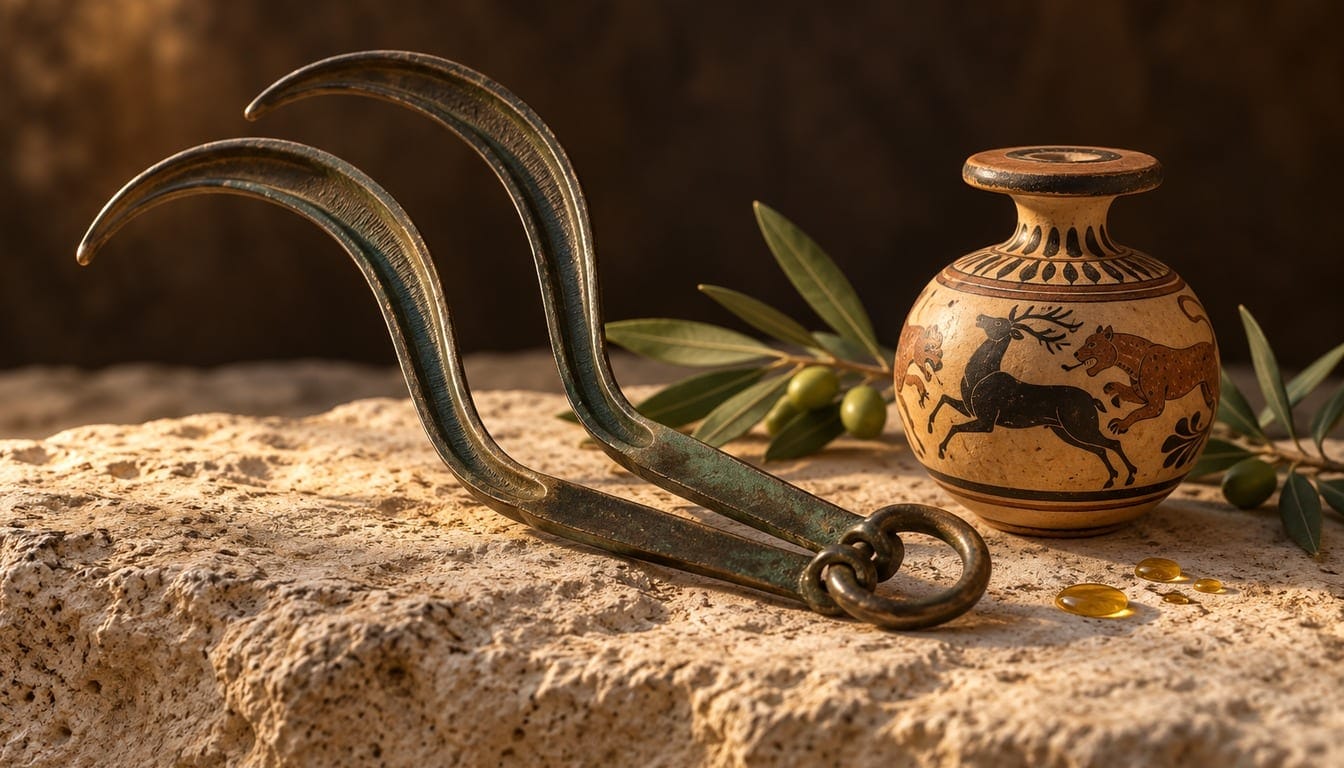
Corinthian Bronze Strigil
Won at Olympia without breaking a sweat?
Scrapes off the oil and the hippodrome dust in three strokes, and comes with its own aryballos of lily perfume. For the champion who never touched the reins, and above all for the one who did.
* Donativo para el proyecto Pultsar News
Comentarios ()