
THE HEMLOCK — Chronicle of Socrates' last day: thirty days in chains, a ship from Delos, and a rooster never paid for
ATHENS, MUNICIPAL PRISON, SPRING OF 399 BC | PERICLES THE YOUNGER | 🎭 GRECIA TIMES · ÁGORA NEWS
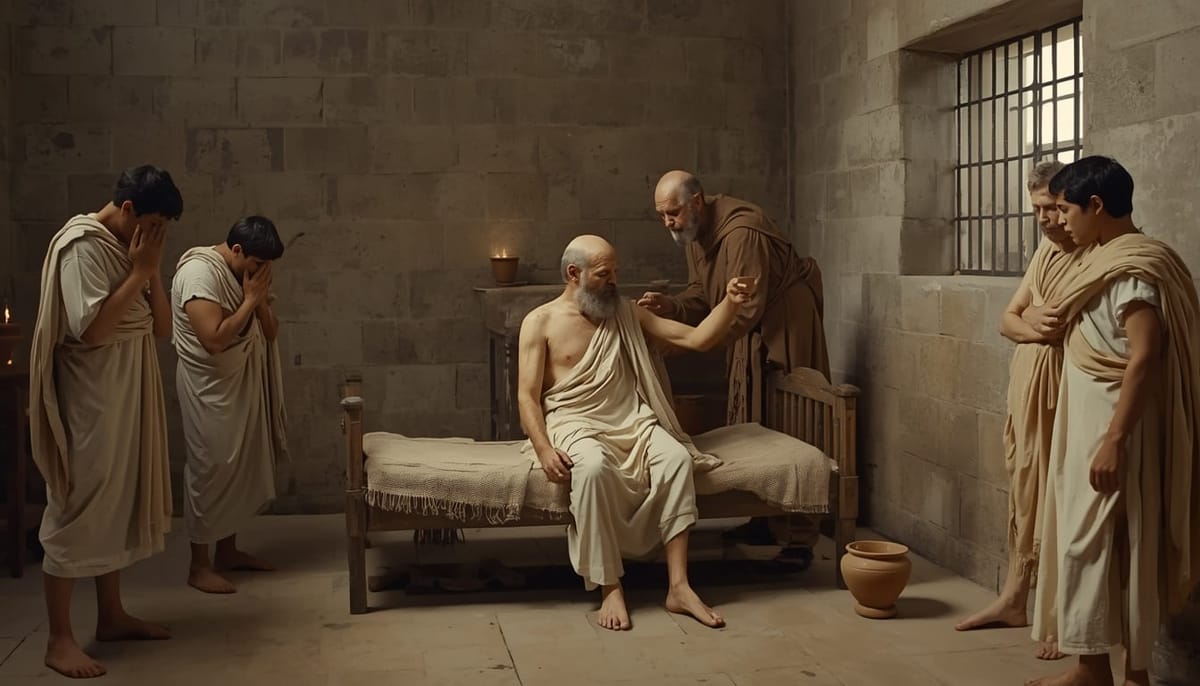
By the hour the sun drops over the Areopagus, Socrates' feet are already cold. He has lain for exactly one hour on the bare plank cot of the Athens municipal prison. The empty clay cup, a cloudy dreg at the bottom, rests face down on the stone floor. Beside him, on a stool, Crito — the lifelong friend, the one who three weeks ago offered to pay the jailer thirty minae to spirit him off to Megara — holds the dying man's hand and listens to the last coherent sentence Socrates will ever address to him:
"Crito, we owe a rooster to Asclepius. Pay the debt, and do not forget it on any account."
Asclepius is the god of healing. The debt is the offering made to the healer when a sick man recovers. Socrates, with the hemlock already climbing his thighs, is giving thanks — with the calm of a guest taking leave of his host — for having been cured of life. The sentence is the last thing to leave his mouth. Phaedo, his youngest disciple, standing three paces from the headboard, covers his face with his cloak and begins to weep without a sound. Apollodorus breaks into cries like an abandoned child. Socrates no longer hears any of it.
He is seventy years old. The eyelids settle. Crito closes his eyes.
Politics: the indictment kept in the Metroon
The sentence that kills Socrates this afternoon was voted exactly thirty-one days ago, in a hall of the Areopagus packed with five hundred and one dikastes — Athenian jurors drawn by lot. The indictment, still preserved today in the archive of the Metroon — the temple of the Mother of the Gods, which serves the city as a public record office — reads as follows:
"Meletus of Pitthos, son of Meletus, charged Socrates of Alopece, son of Sophroniscus, with the following crimes: Socrates breaks the Laws by denying the existence of the Gods the city holds received, and by introducing new ones; and he acts against those same Laws by corrupting the youth. The penalty due is death."
Three accusers: Meletus (on behalf of the poets), Anytus (craftsmen and magistrates) and Lycon (the orators). The real promoter was the second. Anytus, a man of the democratic faction just restored after the Thirty Tyrants, had suffered the disaster of the Thirty in his own flesh — their government lasted eight months, killed 1,500 Athenians, exiled 5,000. And among Socrates' former disciples stood Critias, the bloodiest of those Thirty. There too stood Alcibiades, a traitor by trade. The amnesty of 403 formally forbade prosecuting anyone for his part in the governments of terror, but it said nothing about prosecuting his teacher.
The detail tells itself: today's hemlock is for a religious charge, but the political bill is signed by the Peloponnesian War.
Chronicle: Lysias offered to defend him, and something else happened
On the day of the trial — early in the month of Anthesterion, six weeks ago — Lysias, the most expensive orator in Athens, drafted a defence speech for Socrates of his own accord and presented it to him. Socrates read it. He praised it. And he declined to use it. The explanation he gave Lysias himself, in a single sentence translated across all Greece ever since:
"The piece is good, Lysias. But it does not suit me. May there not be rich robes and sandals that would still not become me?"
Plato — his young disciple, the first book already half-written — tried to climb to the tribunal to speak on the master's behalf. He began: "Being, O Athenians, the youngest of those who have climbed to this place…". They did not let him finish the sentence. The jurors, irritated, shouted him down from the rostrum. Twenty-one of the five hundred and one voted in favour of the man about to speak.
Socrates defended himself alone. As he suspected they would do, he provoked the jury rather than flatter it. The conviction came in 281 votes over the line: 280 for guilt, 220 against. Had thirty dikastes changed their minds, Socrates would have walked free.
After the conviction, the jurors still had to decide the penalty. The two options were death or a fine, on the defendant's own proposal. Socrates, instead of proposing a reasonable fine, proposed that the republic keep him for life in the Prytaneum — the building where the city feeds Olympic victors and war heroes at public expense. That is: Socrates asked, as his punishment, to be treated like the athletes. Eighty more votes then joined the hemlock party.
His disciples managed, at the last, to get him to propose a token fine: twenty-five drachmas from his own pocket (Eubulides says a hundred). The jury was already decided: death.
The Gossip: the ship from Delos and the thirty days
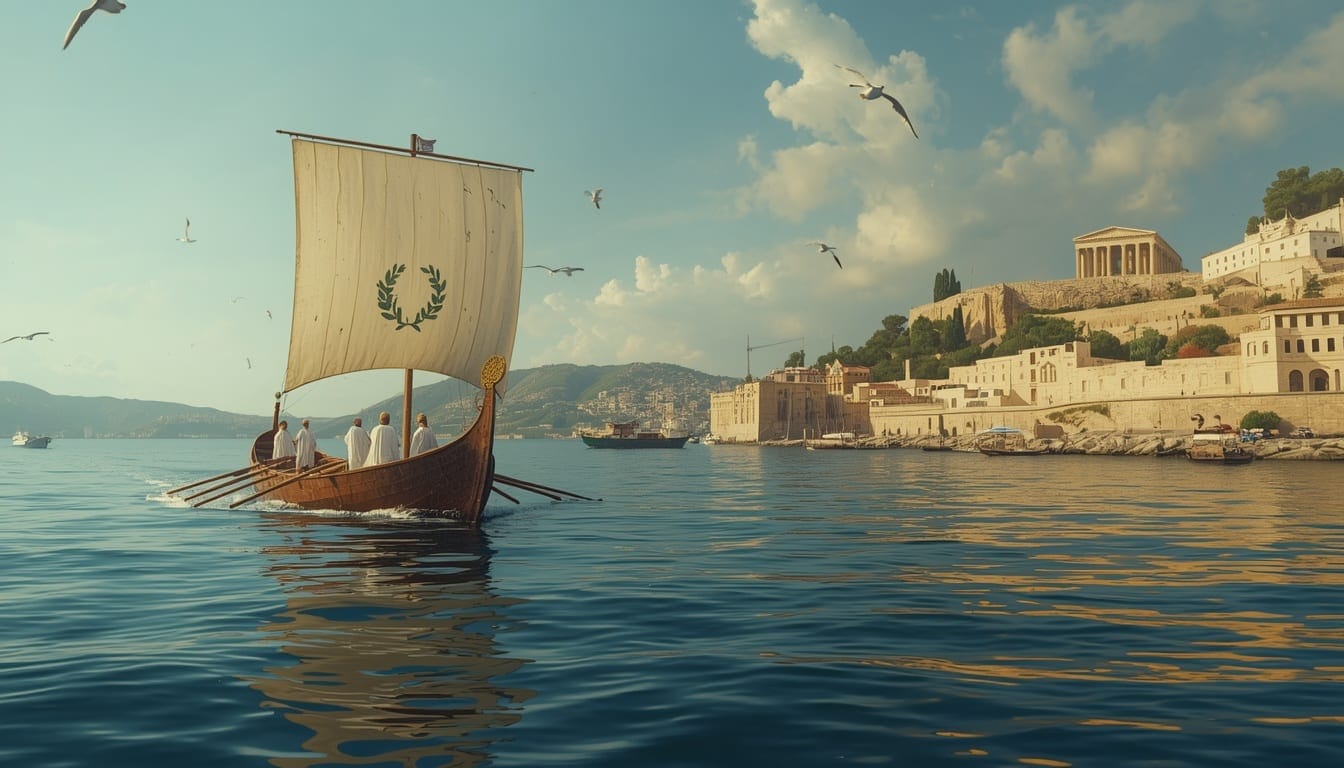
Socrates was seized and taken down to the municipal prison that same day. He should have died there at the next dawn, by custom. He did not die. The reason is the one ritual coincidence that has stretched a Greek philosopher's life by thirty days: the sacred ship from Athens to Delos had set sail the eve of the trial.
Each year, Athens sends a ceremonial ship to the sanctuary of Apollo on Delos to commemorate the mythical voyage of Theseus and the fourteen youths saved from the Minotaur. While the ship is away, no citizen may be executed by public order: the city must remain ritually clean. This spring, contrary winds have kept it out for thirty whole days. Socrates has spent all that time chained by the legs in his cell.
And here enters the human detail that Athenian propaganda will spend the coming centuries trying to bury under archive dust:
Crito had bought his escape from the jailer. The sum is still disputed across the various versions — thirty minae according to some, a whole talent according to others — but the jailer took the bribe and the boat was waiting at Phalerum. Crito reached the cell at the agreed dawn with the fugitive's cloak over his arm. Socrates, wide awake, explained to him that he could not carry out the plan.
The explanation is not rhetorical. It is legal. Socrates argued that for seventy years he had taken advantage of the laws of Athens: they let him marry, have children, raise them, serve as a soldier at Potidaea, Delium and Amphipolis, speak freely in the Agora, train disciples. To break them now, once turned against him, would be the treason of a disciple against his master. Crito returned the money. (Idomeneus the chronicler holds that it was in fact Aeschines who organised the escape, and that Plato assigned the scene to Crito out of narrative sympathy; Pultsar records both versions.)
Xanthippe, his wife, was let in by the prison on the morning of the last day with their three small children in her arms. Socrates, seeing her scream, asked that she be taken home. They led her out before the cup. The youngest — Menexenus, just turned three — did not understand why his father was in chains and would not look at him any longer.
Engineering: how one dies of hemlock
The Athenian mode of execution is, put with clinical coldness, considerably less painful than most of the natural deaths a man of seventy might expect. Hemlock — Conium maculatum, a plant of the umbellifer family — causes an ascending muscular paralysis that begins at the feet and climbs slowly toward the heart. The patient keeps consciousness until the final minutes, when the diaphragm stops moving.
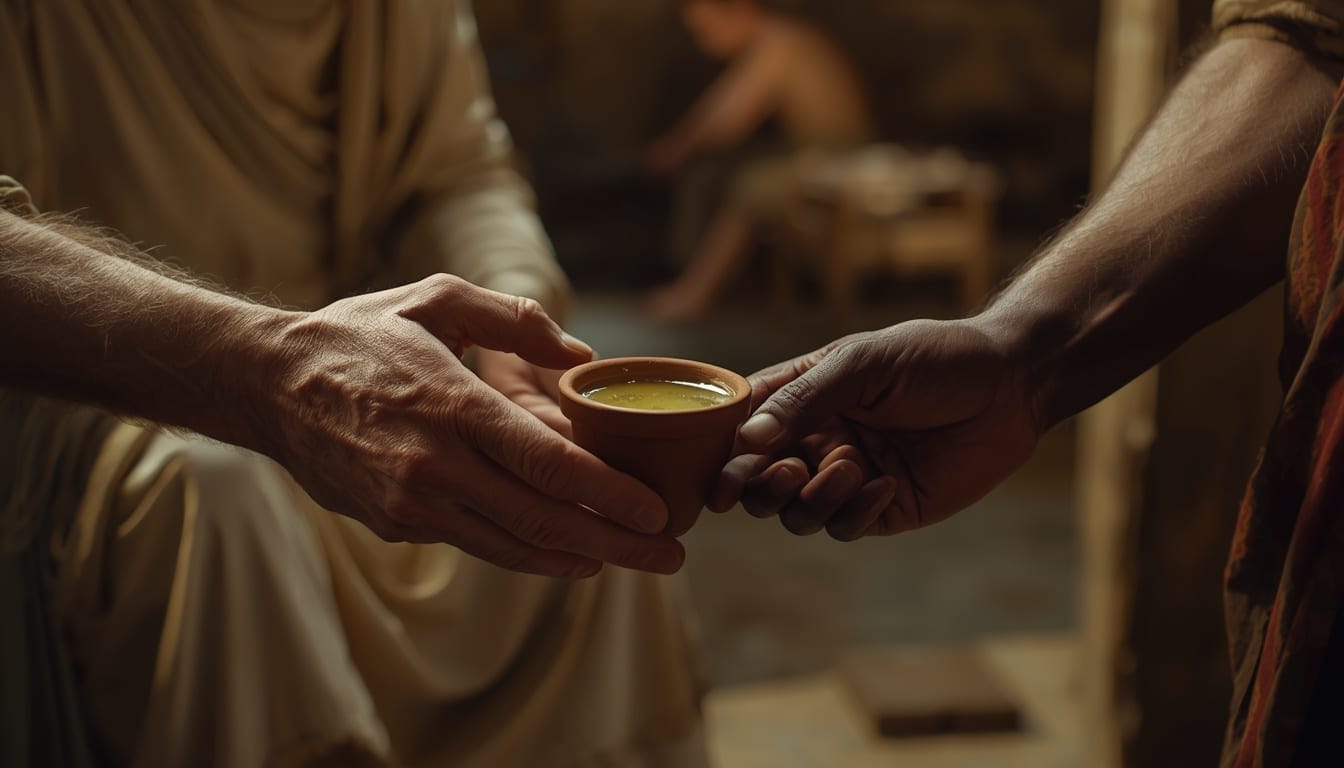
The jailer handed him the cup at the tenth hour of the afternoon. Socrates asked whether he might pour a libation to the gods from the cup before drinking it, and the jailer — weeping, because, Plato says, he had come to be fond of the condemned man over the thirty days of imprisonment — answered that the dose was calculated to the milligram and any libation would reduce its effect. Socrates accepted the professional objection without arguing it. He drank the whole cup in one draught, calmly, like a man draining a glass of water after a hot day's work. He then asked leave to walk about the cell until he felt heaviness in his legs. It was granted.
He walked a few minutes. He lay down. He covered his head with his cloak, the ritual gesture of dying Athenians. Apollodorus, his most sentimental disciple, began to wail aloud. Socrates, without uncovering himself, rebuked him in a voice already weak: "I sent the women away precisely so there would be no scene. It is now that one must die with propriety." Apollodorus fell silent.
Another while passed. When he felt the hemlock rising from his thighs, he uncovered himself for an instant to speak to Crito. It was then that he charged him with the rooster for Asclepius. Then he covered himself again and did not speak more. When the jailer touched the back of his neck to check the pulse, there was no pulse.
Seventy years. Three children. A disciple about to found Western philosophy. A final sentence with a debt in the coin of a rooster.
Reflection: what the cup said that the sentence did not
To this correspondent, who has covered the case from the first hearing, falls the question the Athenian press will dodge in tomorrow's dispatches: did Athens condemn Socrates for impiety, or did it condemn him for having been the teacher of Critias?
For both, badly mixed. The amnesty of 403 forbade trying anyone for his political past after the Thirty Tyrants; the accusation therefore had to disguise itself as a religious charge. But the jury understood perfectly what it was voting. What the hemlock punished was not the new gods but the names of the disciples who had passed through the Agora over the last forty years: Critias — the bloodiest of the Thirty — and Alcibiades — the traitor by trade — above all. A city just out of a bloodbath needs a symbolic culprit, and Socrates was one. He was also already old and lent himself to the role with dignity.
There is a second explanation that some of Socrates' own disciples hold, and that this correspondent notes: the cup was not only political revenge but the accumulated bill of forty years of intellectual humiliation. Socrates spent four decades asking questions in the Agora of craftsmen, magistrates, orators and poets who thought themselves wise, proving to them in public that they were not. That does not make friends. It makes votes when the chance arrives.
Both readings are true and overlap. Athens killed him for both things at once.
Closing: the repentance, the statue by Lysippus, and the verses of Euripides
What happens from now on is no longer Socrates' concern but the chronicler's. Athens will repent very soon. The palaestrae and gymnasia will close during the days of official mourning. Meletus, the first of the accusers, will himself be condemned to death by the Athenian people in under two months; Anytus will flee to Heraclea, where they will expel him the very day he arrives, and he will die in exile without ever receiving a single disciple. Lycon will vanish from public life. In the Pompeion — the civic building where Athens honours its most illustrious men — a bronze statue of Socrates sculpted by Lysippus will be raised, and it will stand there, on a modest pedestal, for the next six centuries.
Euripides, an old enemy of the majority, had already written — even before the trial, in his tragedy Palamedes — these three verses that tomorrow will be quoted in the Agora by all who vote against the next Anytus of the day:
"You have killed, yes, you have killed the wisest, the gentlest of the Muses, who was never a trouble nor a harm to anyone."
And the sentence that closes this chronicle better than any other is not mine to give but Aristippus of Cyrene's — the freest of the Socratic disciples, the one who years later opened a school in Africa and never returned to Athens. When they asked him, well into old age, how his master Socrates had died, he answered with three words that in Greek are shorter still than in English:
"As I wish to die."
— Pericles the Younger, from the municipal prison of Athens.
Chian Wine — Vintners of the Aronte archipelago
Receiving your guests from Piraeus tonight?
The costliest nectar of the Aegean, pressed on the western slopes of the island. Served in a krater with three parts water to one of wine, after the Panhellenic rite. The wine the orator Lysias chose for his last after-dinner with Cephalus in the Piraeus. Exclusive distribution through authorised shipowners; amphorae sealed with the mark of the archipelago.
* Donation to the Pultsar News project


Comentarios ()