
SEW OR DIE! The silent inferno of the East End needlewomen: 14 hours a day for one shilling and sixpence a week
LONDON, EAST END, DECEMBER 1850 | ELEANOR CARLISLE | ⚙️ INDUSTRIAL TELEGRAPH · FLEET STREET SIGNALS
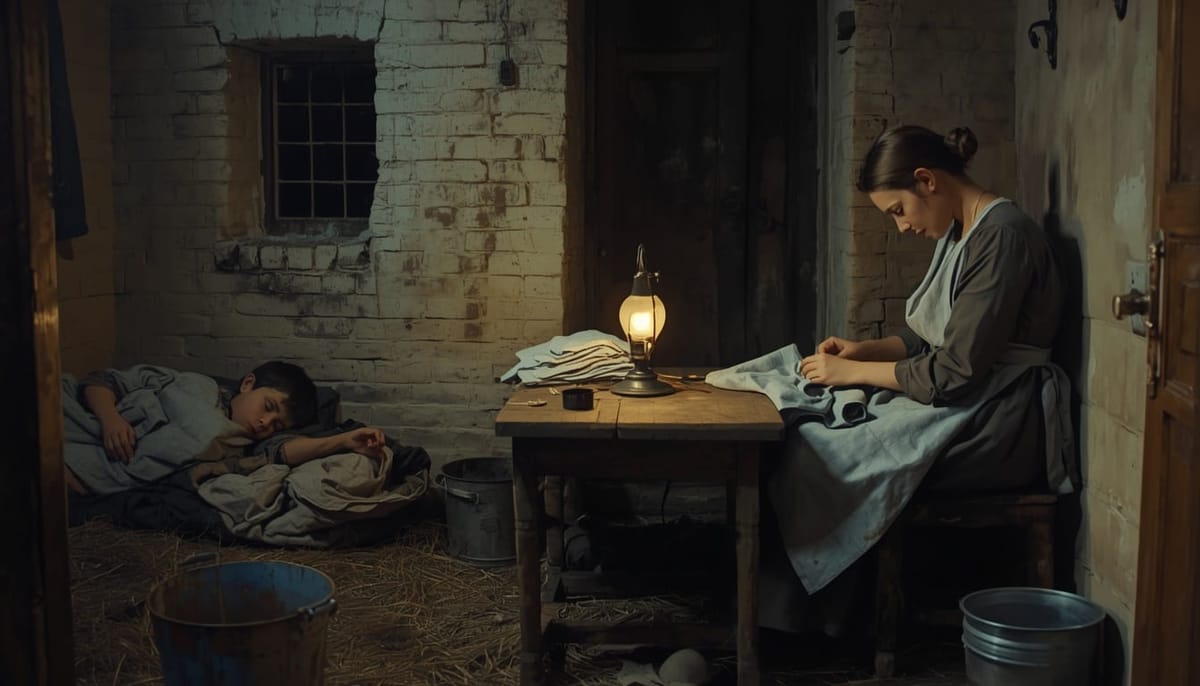
Mrs. R. is thirty-two years old. She sits on a stool beside a table of bare board and sews a shirt of blue linen that tomorrow will be worn by a shop assistant in Cheapside. The room is the only one she has. It measures two and a half metres by three and a half. In one corner her four-year-old son sleeps wrapped in what was his late grandmother's shawl. In the other there is a pail, an empty chamber pot and a bundle of straw on which she herself lies down when she can. The oil lamp, on the table, is an iron bowl with a cotton wick lit since five o'clock in the afternoon. It is twenty past eleven at night. She has two and a half hours of fuel left.
When we ask how many shirts she will sew today, Mrs. R. raises her eyes, fixes them on a point behind us, and says in a flat voice:
“If God helps me, four. If the lamp holds out, five. The fifth never turns out well.”
At a penny and a half per shirt, four shirts are sixpence. The day's basket of food—half a pint of milk, four ounces of cheese, a piece of brown bread and a pinch of tea without sugar—cost her eightpence that very morning. The sums do not add up. They have not added up for seven years.
The figures of a trade that does not fit on a ledger
The price of the finished shirt that Mrs. R. will return tomorrow to her middleman is one shilling and sixpence, or eighteen pence. Of those eighteen, the Cheapside tradesman pays one and a half to the woman who sews it. The remaining sixteen and a half are taken, in order of appearance, by: the sweater, the slop-shop, the wholesaler, the retailer. The shirt will be paid for by the shop assistant at three shillings and sixpence. It will have passed through seven hands, and only one of them will have touched it for twelve hours.
Colonel A’Court, commissioner of the official report of the Poor Law Commission of 1840, set it down in a paragraph that the Westminster press declined to reproduce and that the East End manufacturers still quote without a blush whenever some journalist asks:
“The women all declare that, working between twelve and fifteen hours a day, they cannot earn more than one shilling and sixpence a week. The manufacturers maintain, on the contrary, that with regular work they can earn from four to six shillings in ordinary circumstances. Meanwhile, the demand for seamstresses grows: it is not unusual to see hand-bills posted about the city calling for five hundred to a thousand additional stitchers.”
At Whitechapel prices, one shilling and sixpence a week is eighteen pence. The rent of Mrs. R.'s room is one shilling and threepence. She has threepence left over. For everything: food, coal, clothing, lamp oil, soap, any mishap.
Mrs. R. solves the equation the only way she can: by sewing more hours. Twelve, fourteen, sixteen when fatigue still allows it. The question is not how they endure, but what they must give up in order to endure. The answer, in her case: air, sleep, hot food, the doctor when the child coughs, the winter blanket when the pawnshop already holds last year's two, and the possibility of imagining that the coming month will be any different from this one.
The sweater: the most profitable trade in the East End
There is a figure in this story who never appears in the advertisements and who nonetheless orchestrates everything. They call him the sweater, the middleman, the piece-master. His trade is to buy lots of cut cloth from the Aldgate slop-shop, distribute it on Mondays among the rooms of widows, seamstresses and women with sick husbands, and return on Fridays to collect the finished shirts. The difference between what the slop-shop pays him for delivering the lot and what he himself pays the seamstresses is his wage. That margin varies, according to testimony gathered by Henry Mayhew in his letters to the Morning Chronicle last winter, between thirty and sixty per cent of the price.
A West End tailor, anonymous at his own request, told Mayhew in words that this correspondent repeats verbatim because she could not better them:
“The sweater is the greatest evil we have. The sweating system multiplies labour to infinity. The masters and the sweaters sought everywhere for hands that could find no work elsewhere: widows with children, the wives of sailors gone to sea, Irishwomen newly arrived, dishonoured girls. They drew them all into the trade.”
And another interview, this time with a young Scottish tailor of twenty-one taken down at the Asylum for the Houseless Poor in Cripplegate last week, where he slept three nights having not eaten on two others:
“I lodged with a sweater on the west side of town. I ate and slept under his roof. But at the end of every week he made me come out in debt to him. There were nights I had to sew until dawn. However hard I drove myself, I never managed to get out of the red. There were six of us in the room. Two to a bed.”

The sweater will call on Mrs. R. on Friday at four in the afternoon. He will wear a bowler hat, carry a black leather notebook, and give off a smell of gin that in the neighbourhood has become a mark of the trade. He will count her shirts, pay her the pence owed against the account less the previous debt (there is always a previous debt), and leave on the table the next lot of cut cloth for the coming week.
Why this happens: the arithmetic of a country full of widows
The Empire of Cotton of which they speak in parliamentary addresses needs, in order to keep its prices competitive against the French and American looms, a female working class paid below the cost of subsistence. That class, in the England of 1850, exists in abnormal abundance: the war against Napoleon left hundreds of thousands of widows; the cholera of 1832 and the recurring influenza that returns every winter from India raise male mortality; Irish migration after the Famine brings to Liverpool and London whole families in which the father has died on the boat or in the harbour fever. Friedrich Engels, in The Condition of the Working-Class in England, published six years ago in Leipzig, puts a number on it: in every block of the East End there are between eight and eleven widows with children, without a pension, without a trade, and with no option but the needle, prostitution or the workhouse.
The needle is the least infamous of the three. The other two weigh, in their own way, on everything that is done in these rooms at midnight.
What is not seen: the room, the chamber pot, the dying lamp
There are aspects of this trade that no official report records, because no functionary has spent sixteen hours in a room two by three and a half metres with no ventilation. We set them down here, not out of morbid curiosity, but because the economic reckoning is incomplete without these facts:
- The pail in the corner serves at once as washbasin, scrubbing pail and, when the night is very cold and going down to the common yard is impossible, as a substitute for the chamber pot.
- The lamp burns half a penny's worth of oil a day. When it runs out, Mrs. R. sews by the glow of the grate if any coal remains. If no coal remains, she stops sewing.
- The shawl that covers the child is the only decent garment in the house. It is pawned first thing on Mondays at the Petticoat Lane pawnshop and redeemed on Saturday nights when the sweater's payment arrives. Cost of the weekly loan: one penny. The pawnshop is called, without irony, The Three Balls, after the guild crest of the medieval moneylenders.
- The child does not go to school. The parish school requires a clean shirt and shoes. Mrs. R. sews shirts and has never had one she could call her own.
The question this correspondent has been asking herself for weeks
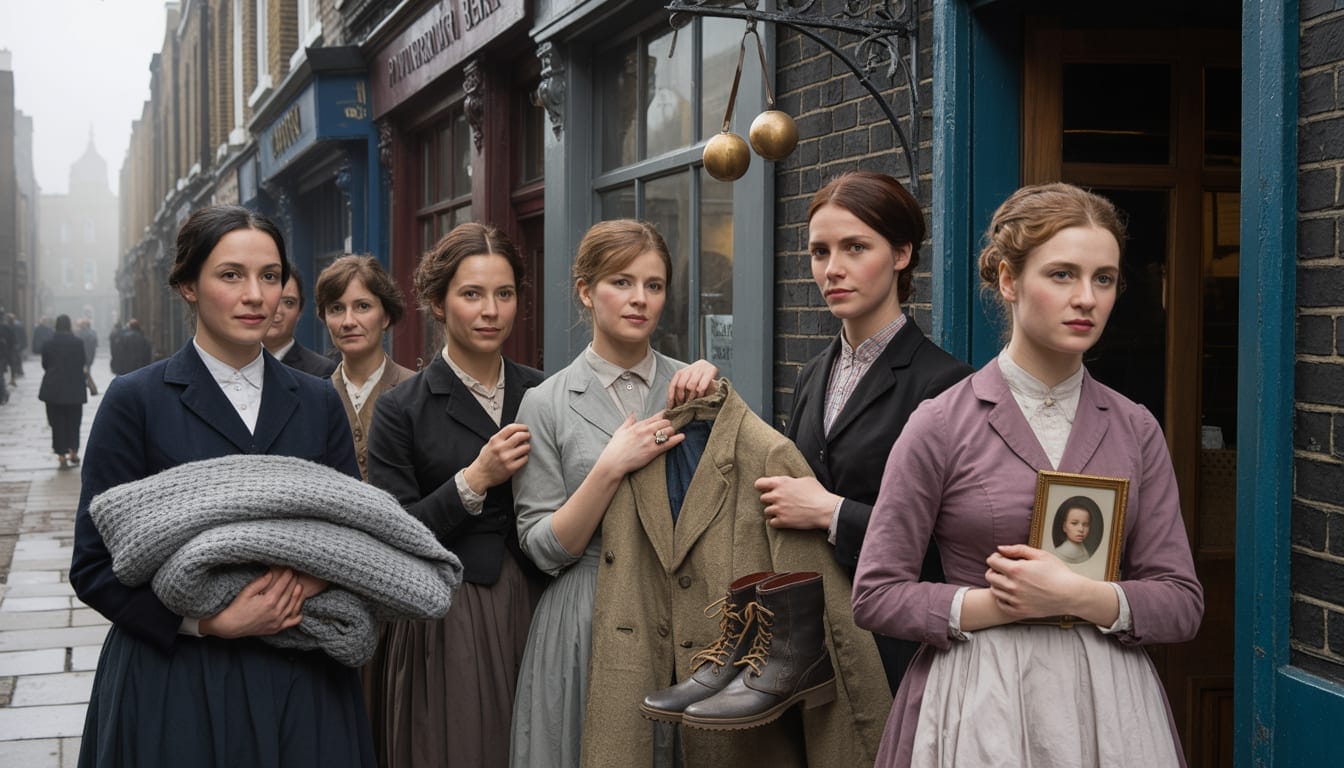
I have spent six weeks going down into the East End. I have spoken with fourteen shirtmakers, three tailoresses, two cobblers' wives and a milliner. The figures repeat themselves. The faces resemble one another. The lamp is always about to go out. The sweater always smelled of gin. The shawl was always pawned.
My question is not why this happens. That the Manchester economists explain with elegance: an excess supply of female labour, elastic demand, a price tending towards the marginal cost of subsistence. The question is another, and I leave it open because it is not mine alone to answer:
At what moment did we decide, as English society, that a grown woman might sew sixteen hours a day for one shilling and sixpence a week, and that this was not a humanitarian emergency but a chapter in the manual of political economy?
When I put it to Doctor Whitehead of the Statistical Society of London, he answers with the formula the gentlemen of Westminster have made their own: “The market, Mrs. Carlisle, finds its level.” When I put it to Mrs. R., she answers with hers:
“If the lamp holds out, five. The fifth never turns out well.”
When we left the room at a quarter past one in the morning, the lamp was still burning. Mrs. R. was finishing the third shirt. The child had been awake for an hour in the corner but had not made a single sound. He knew, at four years old, how long his mother takes to stop sewing when someone interrupts her.
I went down the stairs. In the street it smelled of wet coal and of fog off the Thames. The lamplighters were putting out the last lamps in the street. Tomorrow, in some office in Cheapside, a shop assistant with a starched collar will put on the blue shirt that Mrs. R. will have finished at three this morning. He will not know her name. He has no reason to.
I do. And here it is written.
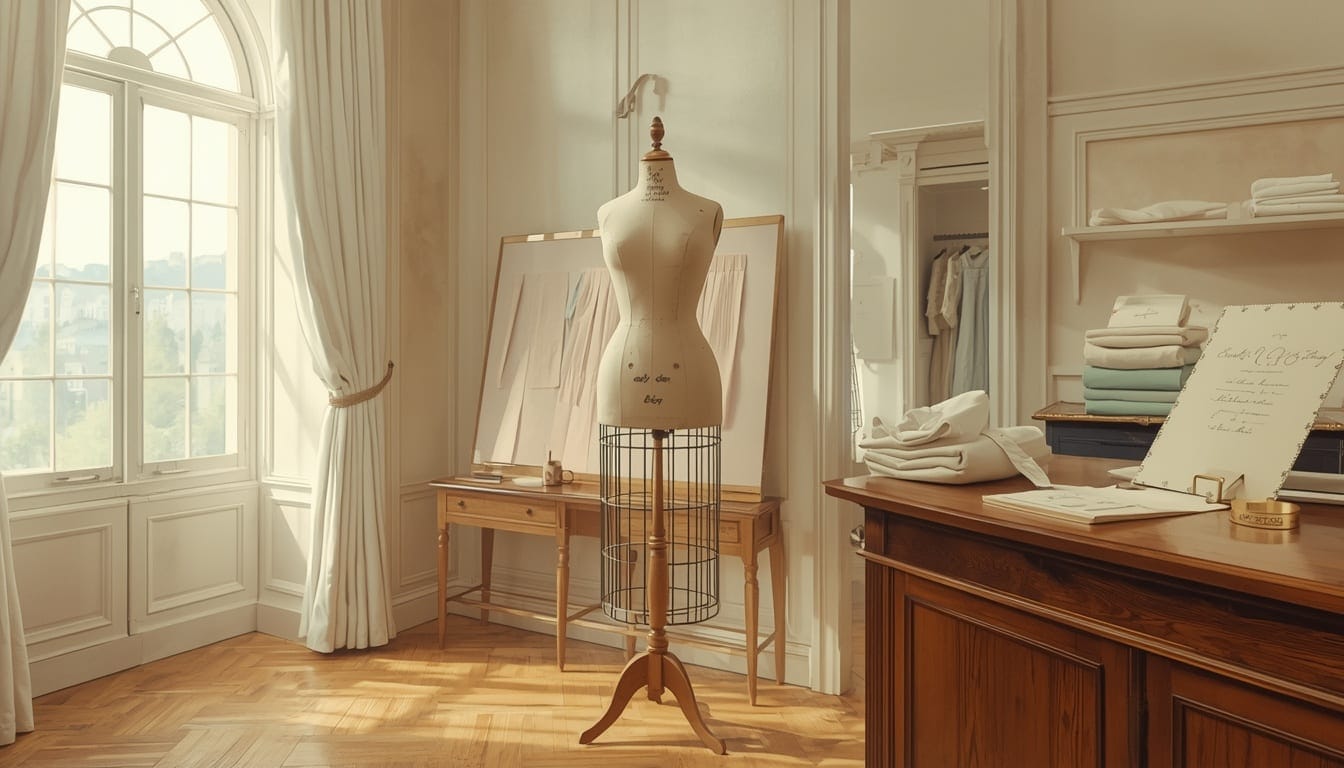
Mr. Thomson's Patented Crinoline — The Belgravia Model
Does your silhouette suffer the rigours of the London winter?
Hoops of tempered steel, impossible lightness, room enough for three petticoats and a hand-bag. Four hoops for the promenade, eight for the soirée. The discreet choice of ladies who attend the opera and of those who sit for their portrait on a Sunday. Our tailors offer you three standardised sizes; the details, in French silk, are customisable to your taste.
* A donation to the Pultsar News project




Comentarios ()