
BLOOD AT SAN JULIÁN! Magellan Crushes the Castilian Mutiny: Mendoza's Throat Cut, Quesada Beheaded by His Own Page, Cartagena Marooned on the Beach
PORT OF SAN JULIÁN, PATAGONIA, 2 APRIL 1520 | HERNANDO OF THE ROUTES | 🧭 GLOBAL HISPANIDAD · INDIES NEWS AGENCY
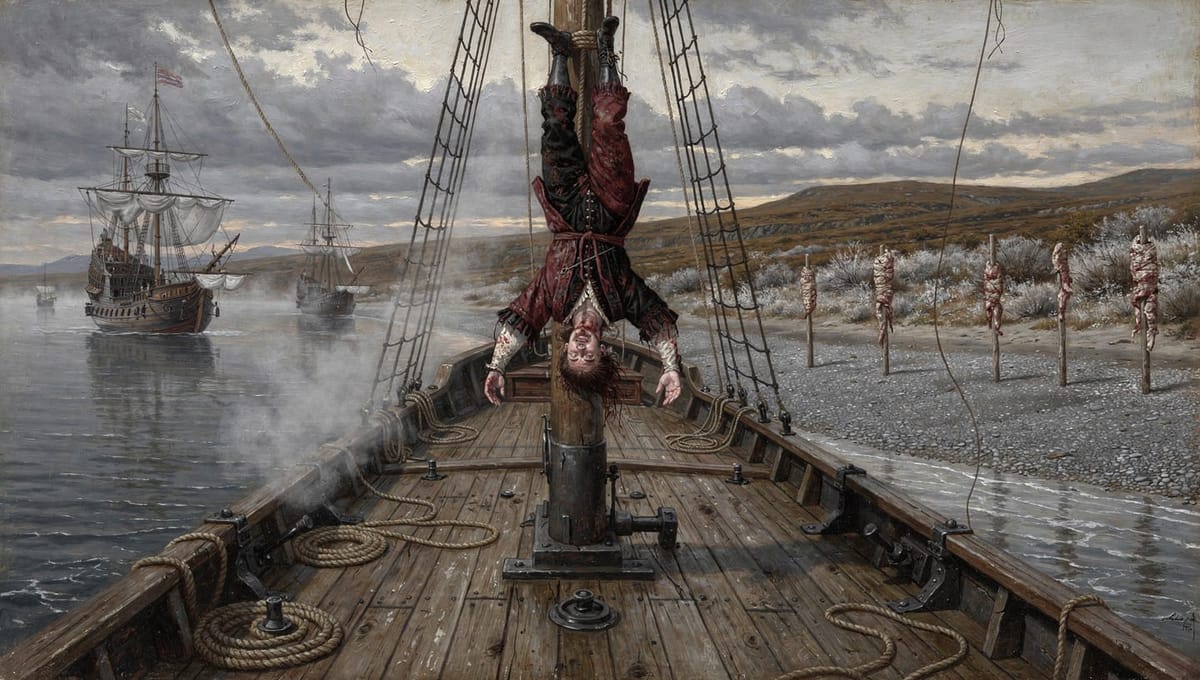
Dawn is breaking over the harbour and nothing the sun is about to light up is pretty. On the slate beach, fixed to stakes, lies a man cut into quarters. His name is Luis de Mendoza; he was treasurer of the fleet, and until two nights ago he slept in the most comfortable cabin aboard the Victoria. On the deck of that same Victoria, swaying with the tide, his body hangs by the feet. Ferdinand Magellan—the Portuguese in the service of Castile—ordered it hung that way so that the other ships would see clearly who had lost the quarrel. Before the day is out, the pieces of Mendoza will be joined by those of Gaspar de Quesada, an Aragonese nobleman, captain of the Concepción, executed at dawn by his own page in exchange for a pardon.
The Palm Sunday Plot
The fleet sailed from Sanlúcar seven and a half months ago. Five ships, two hundred and sixty-five men, a charter signed by Charles V granting the captain general full powers of life and death. The detail is worth remembering: Magellan commands in the name of the king of Castile, not in spite of him. Later propaganda will tell it the other way round. The charter says something else.
At nine o'clock on the night of Palm Sunday, 1 April 1520, with the fleet two days at anchor in this southern harbour newly christened after the saint of the day, the inspector Juan de Cartagena climbs down into his skiff with twenty armed men. He rows to the Concepción to whisper in Quesada's ear. No record was kept of that conversation in the dark. What we do know is that Quesada emerges from it sworn into the conspiracy, and the Concepción neutralized. Cartagena now holds three ships: the San Antonio (his own), the treasurer Luis de Mendoza's Victoria, and the freshly persuaded Concepción. Magellan is left with two: the Trinidad and loyal Juan Serrano's Santiago.
The plan, as one of the pardoned mutineers would later declare before the king's notary, was to board the Trinidad that very night, kill the Portuguese, and return to Spain claiming he had been leading them through seas forbidden by the Treaty of Tordesillas. The exculpatory letter had already been thought out. All that remained was to carry it out.
Constable Espinosa's Ruse
Here enters the man no schoolbook will remember. His name is Gonzalo Gómez de Espinosa, chief constable of the fleet, a Sevillian, on whose behalf Domingo de Barrutia signed because he could not write his own name. Over the next two hours he is about to carry out the cleanest operation of the whole armada.
Magellan—keen of ear and with a network of informants on every deck—has already smelled the plot. He first sends a skiff over on some technical pretext. The rebel faction's answer is curt: “They take no orders but those of Juan de Cartagena, captain major.” The phrase, besides being insolent, is legally revealing. Cartagena has promoted himself. Treason is no longer a possibility: it is now on the record.
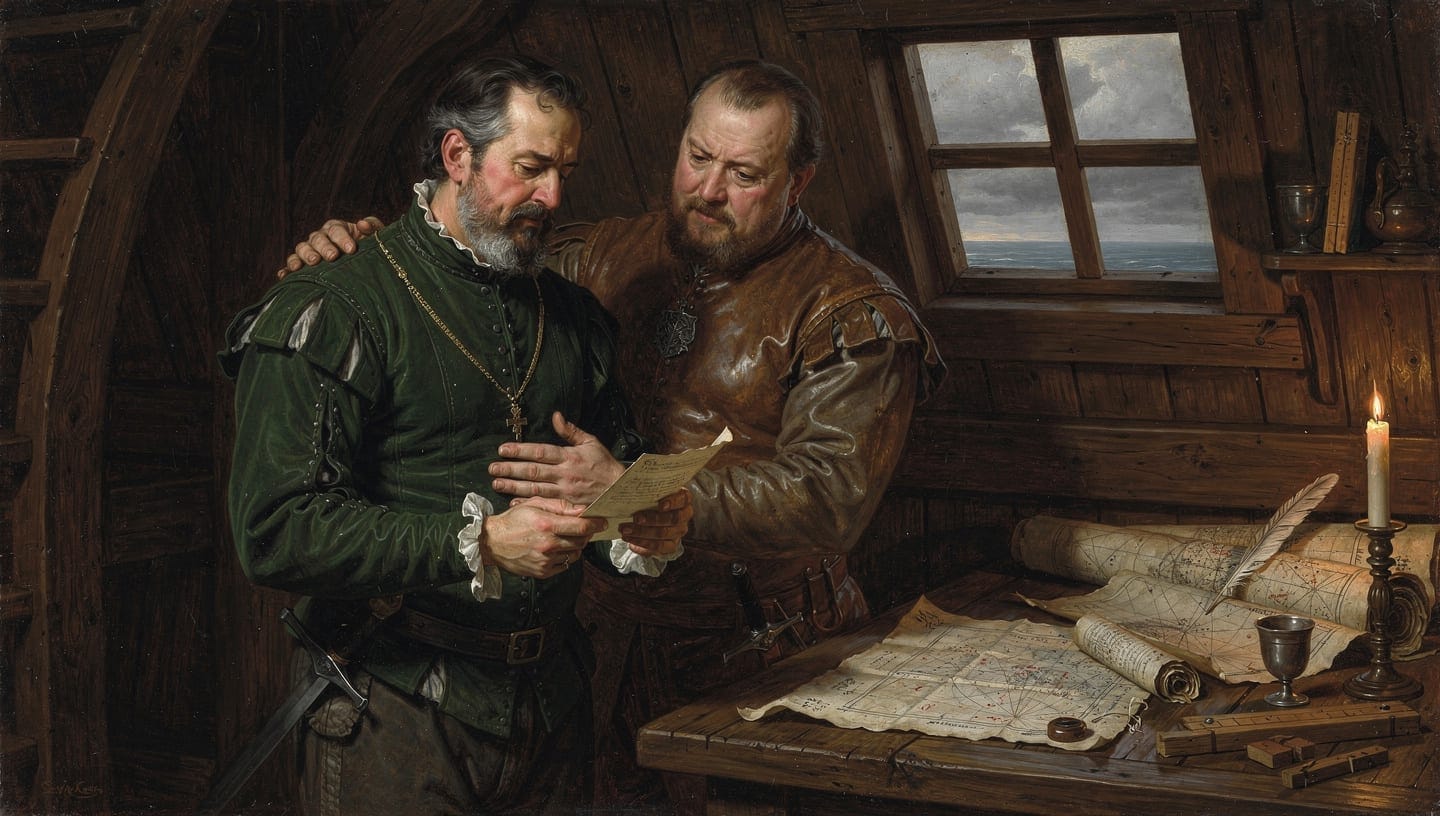
Magellan then summons Espinosa, hands him some ordinary letter for Mendoza, and orders him to go alone, in the skiff, with six men hidden beneath the bulwarks and their daggers tucked into their sashes. Espinosa sets off. Aboard the Victoria they refuse him passage. He insists, with the calm of a man who knows he is about to kill: “What sort of cowardice is this, to refuse one man alone who comes bearing a letter?” Mendoza, his dignity pricked, orders that he be allowed up.
Espinosa delivers the letter, embraces Mendoza warmly, and while the treasurer reads, drives his dagger into his throat. The embrace pins him fast. The six men from the skiff scramble up the bulwark with their swords drawn. The crew of the Victoria, beheaded of their captain, do not know whom to obey during the critical ninety seconds. Magellan has cast off from the Trinidad and the current carries him, with a professional's smoothness, down onto the Victoria. When he comes aboard, he hangs from the yardarms six sailors who had risen against the constable, names Duarte Barbosa—a Portuguese, his wife's cousin—captain, and orders Mendoza's corpse hung by the feet from the mainmast. “Let the others see it.” And the others see it.
Two rebel ships remain. To reduce them, Magellan resorts to the ruse of the planted sailor: he sends a man feigning desertion to Cartagena's San Antonio. At night, aboard and unwatched, the infiltrator cuts the anchor cable. The ship drifts ungoverned toward the Trinidad. Magellan, who was expecting this, comes out on deck shouting “Treason, treason!” and boards at the very moment the decks kiss. Cartagena, surprised in his cabin, has no time to pull on his boots. They clap him in irons. The third mutinous ship, Quesada's Concepción, surrenders without a fight before daybreak.
Three Sentences
On the morning of 2 April, Magellan convenes a tribunal on deck. The three sentences differ.
Mendoza, already dead aboard his ship, is taken to the beach: corpse quartered, public proclamation, town crier's voice, “traitor to the crown of the king-emperor.” The pieces on stakes, in full view of the harbour.
Cartagena is the legal problem. He was appointed captain directly by Charles V, and to behead a man of royal appointment, even for proven treason, is an act the House of Trade will examine under a magnifying glass. Magellan opts for the formula Castilian law allowed in such cases: perpetual banishment in a desolate place, a deferred death sentence in which the condemned dies not by the executioner's hand but by the hand of the landscape. He puts him in irons and postpones the banishment until the day of departure.
Quesada is condemned to death with no mitigating circumstances. And here enters the detail the schoolbook pen will not dare to tell. Quesada has a page, Luis del Molino, a lifelong servant. Magellan offers Molino the following bargain, one that sixteenth-century Castilian law permitted, scandalously and frequently: “Either you mount the scaffold and cut off your master's head yourself, or yours is cut off as an accomplice.” Molino, barely past twenty, eager to see Castile again, agrees to behead his own master. He does it at dawn, on the deck of the Concepción, before the whole crew drawn up in formation. The chronicle does not say whether his hand trembled. It says, in Navarrete's dry line, that “he did the office cleanly.”
Quesada's corpse, likewise quartered, is added to the display on the beach. Three sets of quarters—the two from the quarterings plus the six hanged from the yardarms—under the sun and the southern wind for the five months the fleet will lie anchored here.
The Gossip: The Watched Family and the Father-in-Law's Letter
What is happening at San Julián will not be known in Seville for another year, when the San Antonio deserts the strait months later and returns alone to Andalusia under the command of the envious pilot Esteban Gómez. But there is an earlier detail worth getting ahead of.
Magellan set sail knowing. Before leaving the Canaries, in September 1519, a letter reached him from Seville signed by his father-in-law Diego Barbosa: “The captains you carry under your orders have told their kin in Seville that if you anger them they will kill you and rise against you.” Magellan answers with the cold dignity of a man who has already settled accounts with his own death: “That he would give them no cause, and that he would serve the emperor, for which they had offered their lives.” He keeps sailing.
His wife Beatriz Barbosa and his two small children remain in the house on the Calle de los Mesones, in Seville. The House of Trade will put them under surveillance as soon as the deserter San Antonio docks the following year—the suspicion then, with the piece turned upside down, being that Magellan has struck a deal with the king of Portugal and the family is about to flee. They do not flee. Nor does she see her husband again. Beatriz will die in Seville a few months after Magellan dies on a beach in Mactán at the hands of a chieftain named Lapulapu, without ever having received the news. The two children will not reach adulthood.
— Catalina of the Archives, from Seville.
The Detail That Changes the Whole Story: Elcano at the Pumps
There is a name that does not appear in the proclamations of 2 April because Magellan did not think it important enough. His name is Juan Sebastián Elcano, a Basque from Getaria, master of the Concepción. He took part in the mutiny on Quesada's side. Magellan pardons him along with forty low-ranking mutineers on condition that he spend three months chained to the bilge pumps, drawing water out of the hulls day and night.
Elcano serves his sentence in silence. He returns to the deck. He keeps sailing. Three years and three months later, in September 1522, it will be he who docks at Sanlúcar in command of the sole surviving ship—the Victoria, yes, Mendoza's very own, now under a clean flag—completing the first circumnavigation of the planet. Charles V will decorate him with a coat of arms whose motto reads “Primus circumdedisti me.” You, the first, encircled me.
The official hero of the circumnavigation began as a mutineer. The textbook version never tells it that way.
Closing: August, the Beach, and the Silence
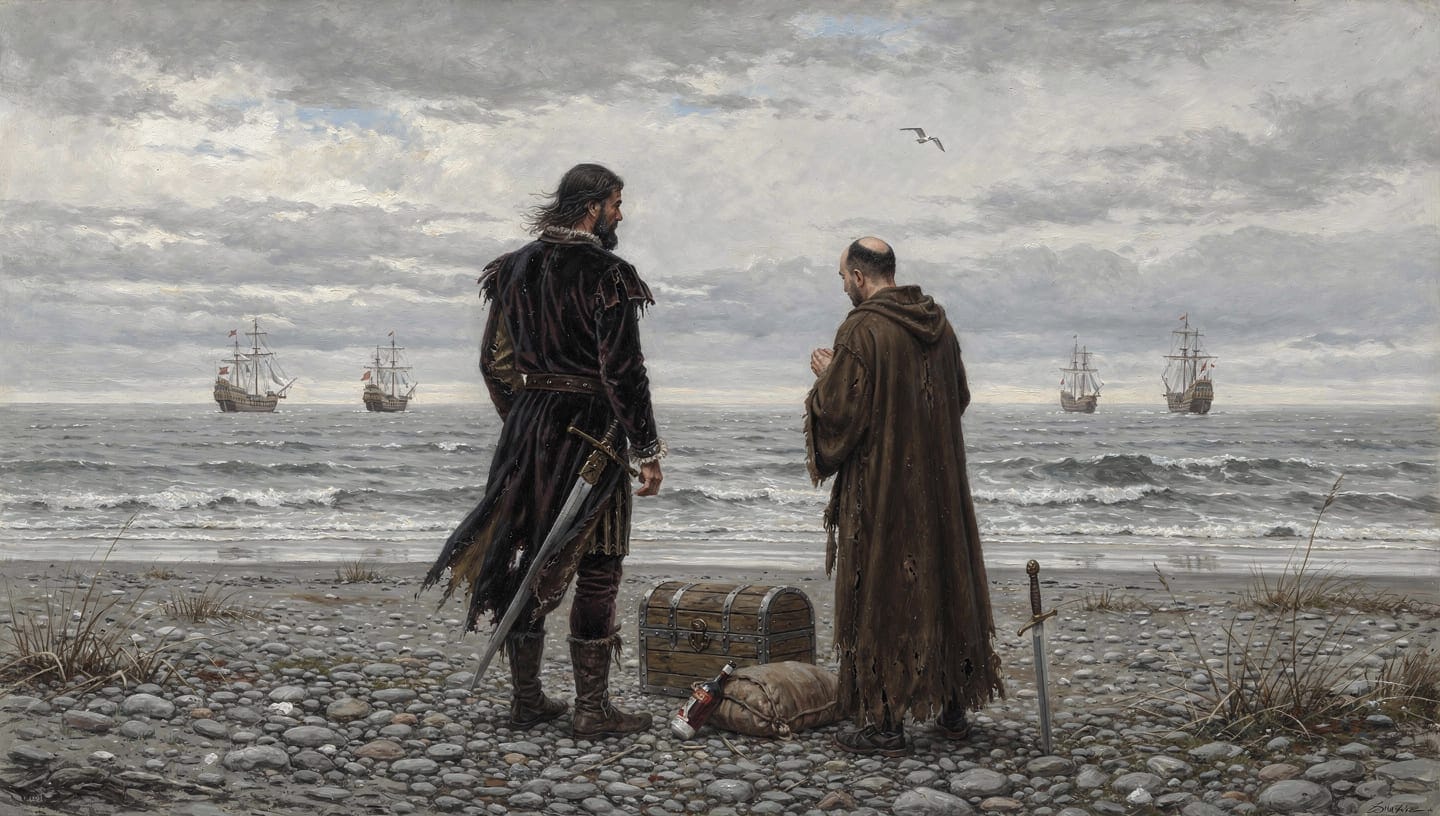
The fleet sailed from San Julián on 24 August 1520. Thirteen days earlier, on 11 August, Magellan carried out the last pending sentence: Cartagena's banishment. He left him in a cove several leagues from the anchorage, with little food, a sword, and a skin of water. He was joined by the cleric Pero Sánchez de Reina, the chief chaplain who had made himself conspicuous during the mutiny by preaching against the Portuguese from the pulpit of the San Antonio. Magellan did not execute him, being a man of the Church. He abandoned him on the beach, which in his jurisdiction amounted to the gallows.
When the fleet spread its sails to the south in search of the strait that the cosmographer Martin Behaim had drawn on a map no cartographer of the king of Portugal was willing to confirm, Cartagena and Sánchez de Reina were left alone watching the five sails vanish on the horizon. Behind them, the quartered remains of Mendoza and Quesada had spent four months under the southern sun. The Loaísa armada passed through here in January 1526 and found the beach empty, only two half-fallen wooden crosses some sailor had driven in by way of remembrance. The sentence had been carried out without an executioner.
In Seville, Beatriz Barbosa goes on watching the Guadalquivir every morning, waiting for the return of the five sails. Only one will come back. And inside it, chained to the past in a chapter not even the coat of arms will recall, will come the Basque Elcano, his hand calloused from three years at the pumps, ready to enter official history through the front door.
Master Olarra's Furs — Furrier on the Calle Sierpes
Wintering at court, or shipping out with an Indies armada?
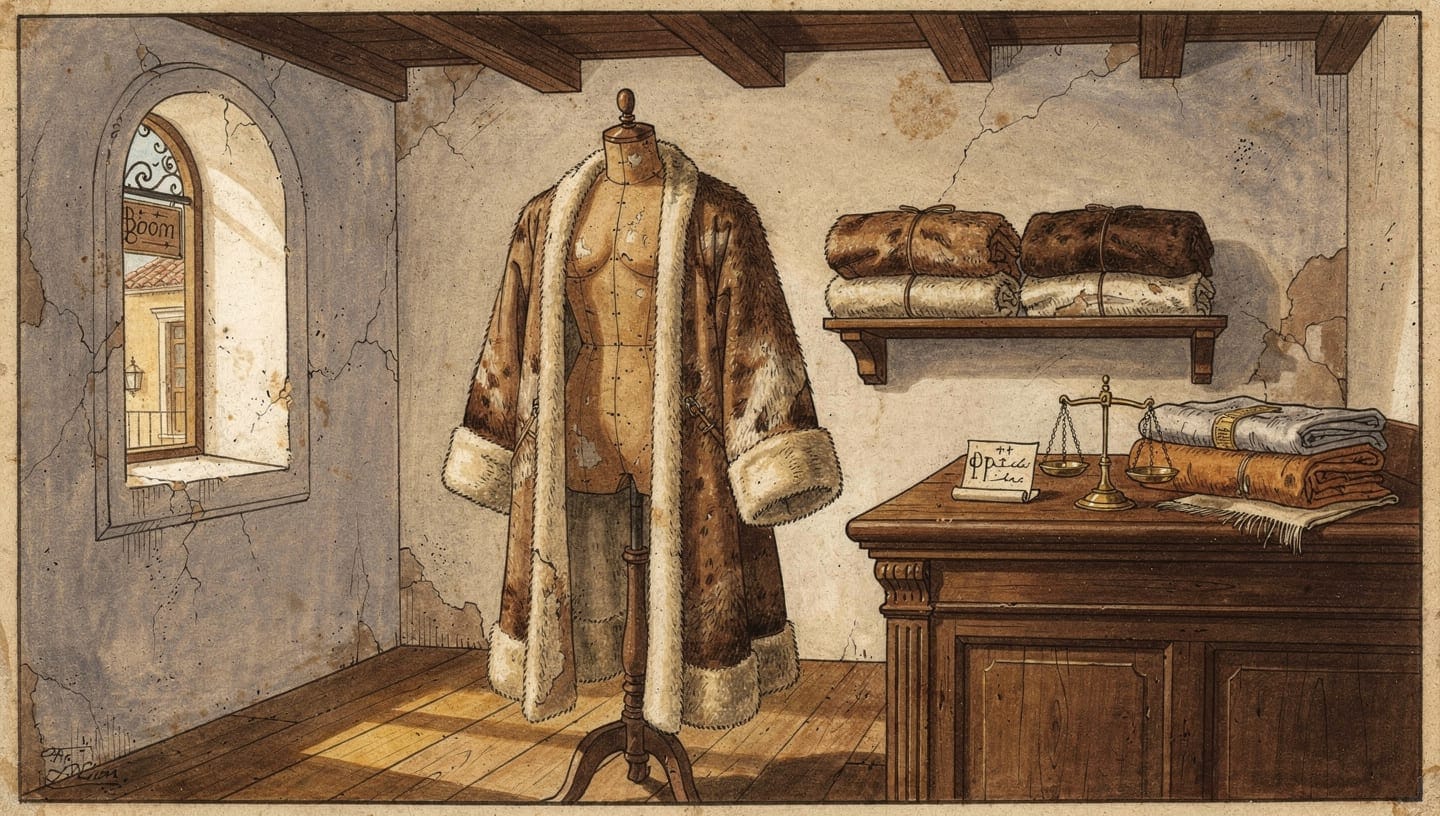
Patagonian guanaco cloaks lined with merino wool, brought back on the latest Indies run. They repel salt water, keep you warm on the high seas, and conceal the belly of a lettered hidalgo. The coat the pilots wear when they report to the House of Trade. Pay once, stay warm for three crossings.
* Donation to the Pultsar News project


Comentarios ()