
PHARAOH ALONE AGAINST TWO THOUSAND FIVE HUNDRED CHARIOTS! — That's how the temples tell the battle of Kadesh. The men who were there remember it differently
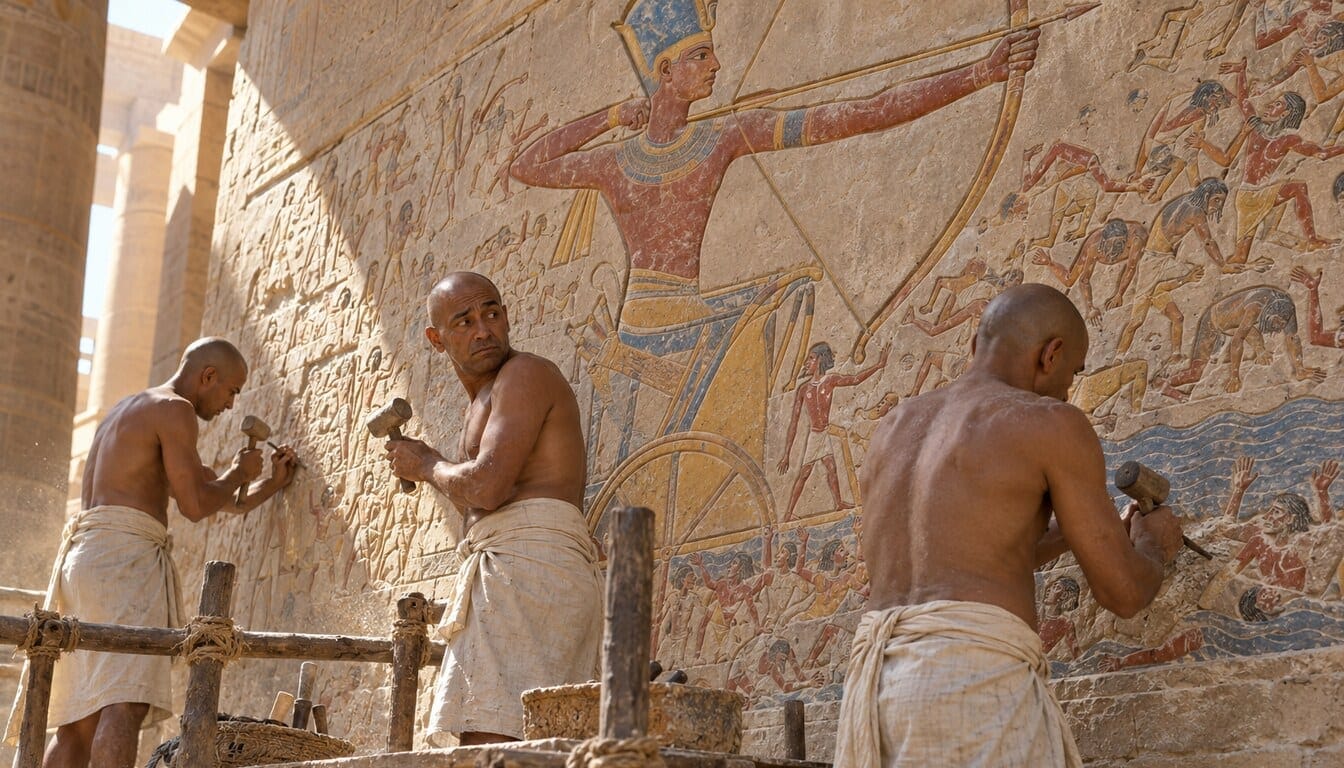
Thebes, west bank. The chisel rings dry against the sandstone. Up on the scaffolding, three sculptors are finishing a scene that covers half a wall of the great temple King Usermaatre Setepenre, Ramesses to his friends, is building himself for eternity. In the middle, huge, the pharaoh stands in his chariot, drawing his bow. All around him, tiny, hundreds of Hittites fall, flee, drown and beg for mercy. Not a single Egyptian at his side. The king is alone.
That is how the battle of Kadesh went, according to the walls. So say the walls at Karnak, at Luxor, at Abydos, and the ones going up now in Nubia, at Abu Simbel. So says a poem the scribes are copying onto papyrus and that half the taverns in Thebes already know by heart. The king, alone, against two thousand five hundred Hittite chariots, and he won.
Down at the foot of the scaffolding, a man of about forty is hauling baskets of rubble. He limps a little. I ask him if he knows what the scene shows.
“I know,” he says, without looking up. “I was there. In the division of Ra.”
And he carries on with his basket.
Legions: what happened by the Orontes
Almost ten years ago, in the fifth year of his reign, Ramesses marched into Syria with the largest army Egypt had ever seen: over twenty thousand men in four divisions, each named after a god: Amun, Ra, Ptah and Seth. The target was Kadesh, a fortified city on the Orontes river that had changed sides once too often. A month’s march through Canaan.
Near the city, the soldiers picked up two Shasu bedouin who claimed to be deserters. They told the king what he wanted to hear: that the Hittite army was far away, at Aleppo, and that its king, Muwatalli, was afraid to come south. Ramesses believed them. He pushed ahead with the division of Amun, crossed the river and pitched camp northwest of Kadesh, with the rest of the army strung out for miles behind him.
Then two more spies were caught, real Hittite ones this time. A beating got the truth out of them. “Look, the vile chief of Khatti has come together with the many foreign countries that are with him,” they are said to have confessed, “they are standing equipped and ready to fight behind Kadesh the Old.”
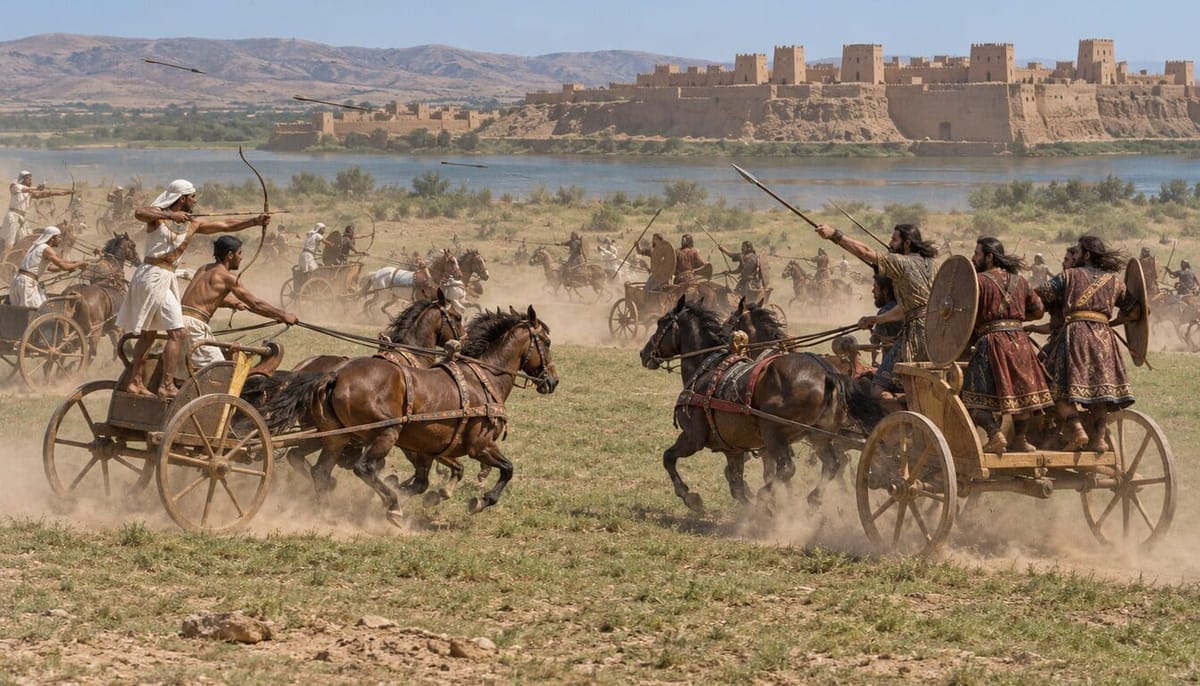
Too late. While the king was dressing down his officers, the Hittite chariots came out from behind the city, crossed the Orontes and slammed side-on into the division of Ra, which was on the march, in column, expecting nothing. They cut it in two. The survivors ran for the king’s camp with the Hittites at their heels, and the panic spread to the division of Amun.
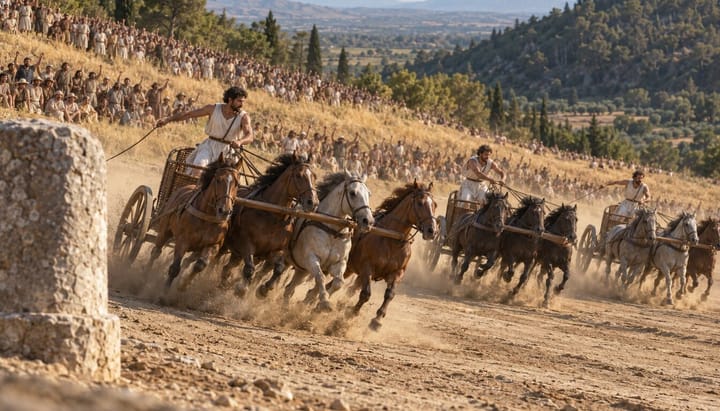
“Their chariots carry three men,” the veteran explains during a break, drawing with his finger in the dust. “One drives, one fights, one covers him with a shield. Ours, two. When a line of those comes at you, you don’t think about gods. You think about running.”
What saved the king, and here the walls do get it right, was his own desperate charge into the Hittite flank and, above all, a relief force that turned up along the coast road. The Hittites, who were already looting the Egyptian camp, found themselves trapped. Many died in the river. The next day there was another clash, neither army could break the other, and it ended the way battles nobody wins always end: everyone went home saying they’d won.
Kadesh, mind you, is still Hittite.
The official version: “I was alone”
The poem recited in Thebes tells the same story with a different cast. In it, the king is left alone because his soldiers desert him, and he says as much to the god Amun: “What is this, my father Amun? Has a father ignored his son?”
And then the line the sculptors have to turn into stone: “No officer was with me, no charioteer, no soldier of the army, no shield-bearer.” Just him, his chariot, his horses, and Amun reaching out a hand from Thebes. The result, in the poem, is a massacre: the Hittites plunge into the water “as crocodiles plunge”, one on top of another.
Afterwards the king gathers his troops, and not to thank them: the poem has him throw their cowardice in their faces, officers, soldiers and charioteers one by one. The veteran from the division of Ra knows that part by heart. He doesn’t say anything else. He just spits on the ground and goes back to work.
Society: the king’s horses
The most human thing in the poem isn’t the gods, it’s the animals. The two horses that pulled the royal chariot were called Victory-in-Thebes and Mut-is-Content. Ramesses gives them a whole passage: they alone, he says, held him up when he fought alone against many lands. And he has promised that as long as he lives in his palace, they will eat their fodder in his presence every day.
In the royal stables they tell it with pride, and a touch of envy. More than one Kadesh veteran grumbles that nobody ever promised him that much, while Victory-in-Thebes eats his fodder in front of the pharaoh.
The king’s shield-bearer, a man called Menna, gets his moment too. According to the poem, when he saw the tide of chariots his legs gave way: “My good lord, strong ruler, we stand alone in the midst of battle, abandoned by soldiers and chariotry.” Ramesses answered the way kings answer in poems: “Stand firm, steady your heart, my shield-bearer!” Poor Menna has been immortalised, fear and all, on walls across half of Egypt. Nobody asked him if he wanted to be in it.
Gossip: the prince upside down
Two bits of gossip are doing the rounds on the scaffolding.
The first is carved, and it’s what gets the biggest laugh from visitors. In one corner of the relief a figure hangs upside down, held by the ankles by his own men: the prince of Aleppo, the Hittites’ ally, who fell into the Orontes during the rout and had to be fished out and turned over to bring up everything he’d swallowed. The king wanted that one to be clearly visible.
The second isn’t carved, but the stonemasons all know it. Plenty of the blocks in this building, and in other works of the king’s, come from the monuments of earlier pharaohs. And on more than one old statue, the name of the king who commissioned it has been chiselled off and Ramesses’ put in its place. That’s how you make a reign bigger: carve what didn’t happen and erase what others did.
“And in Khatti they say they won,” the veteran adds, no longer hiding that he’s enjoying himself. “A merchant told me. Over there, the winner is Muwatalli.”
“My brother”
The sun sinks behind the western mountains and the sculptors climb down from the scaffolding. One of them, the youngest, stays looking at the wall, at the giant king and the tiny Hittites.
There are rumours at the palace. Muwatalli is dead, and his brother Hattusili, who was at Kadesh, now rules in Khatti. They say messengers have arrived, that tablets are going back and forth, and that in those tablets the two kings no longer call each other “the vile foe” but “my brother”.
The young sculptor scratches his head, white with stone dust.
“If they make peace,” he asks no one in particular, “will we have to chisel all this off?”
Nobody answers.
Neferet covers the court and the army for Egipto Oracle. The words of the king, the spies and Menna come from the Poem and the Bulletin of Kadesh, inscribed by Ramesses II in his temples (translated by Miriam Lichtheim, “Ancient Egyptian Literature”, vol. II); the figures and the course of the battle, from Toby Wilkinson’s “The Rise and Fall of Ancient Egypt”. A few years later Ramesses and Hattusili will sign a peace treaty that survives in both sides’ versions, something unique in the ancient world: the Egyptian one on the walls of Karnak, the Hittite one on clay tablets.
Wadi Natrun Natron, "Fresh Pharaoh"
Smell like a warhorse?
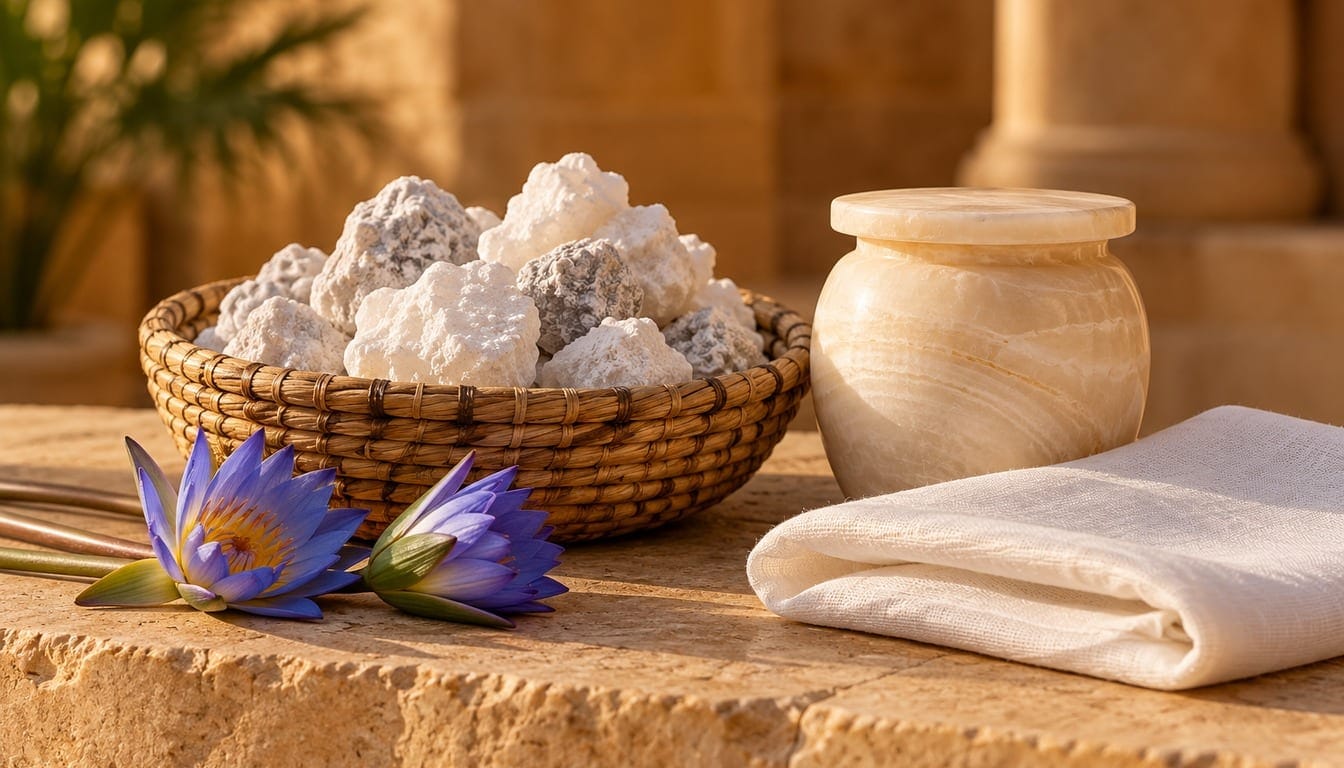
The same natron the Houses of Eternity use, but for the living. Cleans the skin, whitens the teeth and gets rid of that chariot-and-stable smell. Recommended by shield-bearers who have seen their lord up close.
* Donativo para el proyecto Pultsar News
Comentarios ()