
CHRONICLE: The Healthcare System of the New Kingdom: Copper Scalpels, Botanical Pregnancy Tests and the Magical "Software"

Year 1360 B.C.
Welcome to Thebes, the vibrant and cosmopolitan capital of the New Kingdom under the glorious reign of Amenhotep III. The economy is booming, the temples gleam with Nubian gold and the Nile flows on schedule. But what happens if, in the midst of this Golden Age, you break a leg, get bitten by a crocodile or simply develop a toothache?
Forget the notion that in Antiquity everything was cured with leeches and desperate prayers. The healthcare system of Kemet (Egypt) is the most advanced medical network in the ancient world, a fascinating combination of surgical hardware of precision, empirical pharmacology and a magical software designed to hack the demons that cause disease. If you have good health insurance (or work for the State), you are in good hands.
The medical org chart: From the Swnw to the Wabau
Egyptian medicine is no amateur's trade; it is strictly hierarchical. At the base of the health pyramid we have the swnw (general practitioners), State officials who tend to public works, the army and the villages. But if you are one of the elite, you will want to be treated by a wabau (pure priest-physician).
These high-ranking specialists are usually attached to the cult of Sekhmet, the lioness goddess. Sekhmet is the deity of plagues and epidemics, which means her priests operate under an impeccable business model: the very goddess who sends you the virus is the only one who holds the update patch to cure it. All research and development (R&D) is centralized in the "House of Life" (Per-Ankh), the laboratories and archives attached to the great temples where scribes copy and update the medical papyri.
The trauma algorithm: The Edwin Smith Papyrus
If you suffer a workplace accident while building a tomb, the physician will apply a triage protocol that would make a modern surgeon turn pale. As documented in the famous surgical treatise we know today as the Edwin Smith Papyrus, the physician examines the wound and issues one of three strict diagnoses:
- "An ailment I will treat" (You can be saved, we proceed to operate).
- "An ailment I will contend with" (The prognosis is guarded, we will try to stabilize you).
- "An ailment not to be treated" (The damage is lethal, we will give you palliative care so that your journey to the Afterlife is painless).
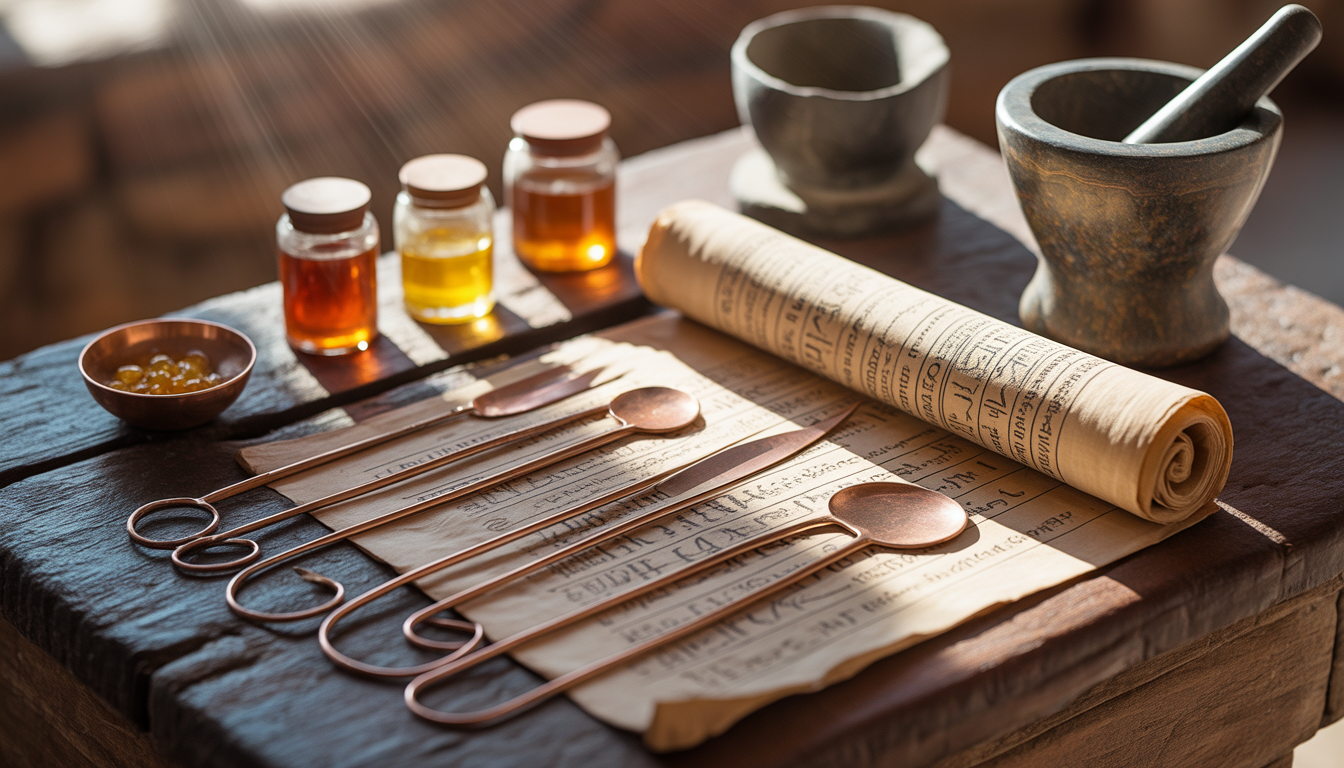
For open wounds, the hardware includes sutures with needle and thread, and the application of raw meat on the first day to stop the bleeding, followed by ointments of honey and grease. Honey, as we know today, is a first-rate natural antibacterial. No magic here, just pure applied science.
Extreme dentistry: The problem with wholemeal bread
If trauma surgery is excellent, dentistry is the system's great failing. Average life expectancy hovers around 35-40 years, and much of the blame lies with the diet. Bread is the cornerstone of nutrition, but stone mills leave micro-residues of sand and quartz in the flour.
The upshot is that Egyptian bread feeds you, but it also sands down your teeth. Dental wear (attrition) is so severe that the pulp becomes exposed, causing lethal abscesses. The Egyptians believe that tooth decay is caused by the fnt (a mythical "tooth worm" that burrows into the enamel). With no specialist dentists to perform root canals, treatment is purely analgesic: chewing natron (a natural salt) to disinfect, or applying a paste of cumin and terebinth resin to numb the pain. If the abscess is very severe, the physician will use a copper scalpel to drain the pus. If that fails, prepare to meet Osiris ahead of schedule.
Gynecology and family planning: The Kahun Papyrus
Where Egyptian medicine truly shines for its ingenuity is in reproductive health. The women of Kemet have access to surprisingly effective contraceptive methods and pregnancy tests.
If a woman wishes to avoid pregnancy, the midwife or the village wise woman will prescribe a pessary (a cervical plug) made of dried crocodile dung mixed with honey. Although it sounds like divine punishment, modern science has shown that crocodile dung has highly alkaline properties that act as a potent spermicide, while the honey creates a sticky physical barrier. A 100% organic barrier contraceptive.
And if pregnancy is suspected? The diagnostic test is brilliant. The woman must urinate each day over two sacks of seeds: one of barley and one of emmer wheat. If neither seed germinates, there is no pregnancy. If the barley germinates, it will be a girl; if the wheat germinates, a boy. Twentieth-century research demonstrated that the high levels of estrogen in a pregnant woman's urine do indeed make the seeds germinate in 70% of cases. The Egyptian botanical hardware worked.
The Magical "Software": Sanatoria and Incantations
For the Egyptians, there is no distinction between science and religion. If the origin of the illness is visible (a broken bone), rational medicine is used. But if the illness is invisible (a virus, a fever, a parasite), it is assumed that the immune system has been hacked by a demon, a ghost or the evil eye.
This is where the magical software comes in. For the common cold, the physician will prescribe a potion, but it will not work unless the proper voice command is executed: "Flow out, fetid nose! Flow out, you who break the bones and destroy the skull!".
For chronic illnesses or depression (known as "dryness of the heart"), patients go to the temple sanatoria. There they practice "dream incubation." They sleep in dark cells perfumed with incense, hoping that deities such as Imhotep (the deified architect) or Hathor will appear to them in dreams to prescribe the cure or reset their mental state. The placebo effect, combined with rest and the therapeutic environment, often achieves miraculous results.
In short, surviving in Ancient Egypt requires dodging hippos, Nile parasites (such as schistosomiasis) and desert dust. But if you fall ill, you can rest assured that the State will cover you with paid sick leave (as the attendance records of Deir el-Medina demonstrate), expert surgeons and, just in case, a good incantation to keep the demons at bay.

Premium Appointment with the "Swnw" (And His Incantation)
Tired of modern social security? Book an appointment with a physician on the staff of the Pharaoh's Court. Our surgeons guarantee a 90% success rate in setting bones and a 50% chance of surviving cranial surgery. Includes a prescription from the Ebers Papyrus and an Eye of Horus amulet as a gift. Ask about our specialty in Proctology (the respected "Shepherds of the Anus").
* Donation for the Pultsar News project




Comentarios ()