
FEATURE: Khufu's Megaproject: How Hemiunu Managed History's Greatest Public Works Without Excel
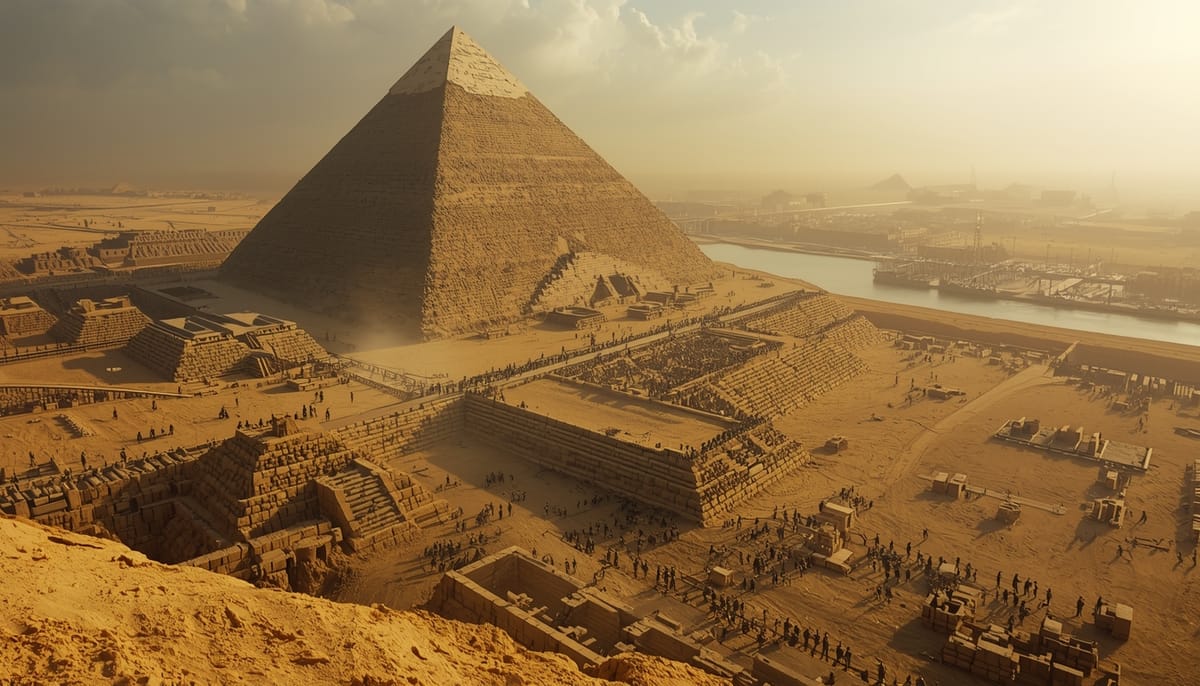
Year 2547 BC.
If you think your boss is demanding because he asks you for a report by Friday at the last minute, imagine that your CEO is, literally, the incarnation of the sun god on Earth, and his assignment is to build him an artificial mountain 146 metres tall, perfectly aligned with the cardinal points, before he passes into the afterlife. Oh, and you have no pulleys, no wheels, no compasses, no cranes. Only copper, stone, wood and a great, great deal of beer.
Welcome to the Giza plateau in the year 2547 BC. Forget the Hollywood myth of starving slaves under the lash. What we have here is the equivalent of antiquity's NASA: a logistical, administrative and engineering machine so precise it would bring any Silicon Valley project manager to tears of joy. At the helm of this monumental startup called "Akhet Khufu" (The Horizon of Khufu) is the vizier Hemiunu, the pharaoh's cousin and the brain behind the Great Pyramid.
Hemiunu: The CEO of the Horizon of Khufu
To raise 2.59 million cubic metres of stone (some 2.3 million blocks), Hemiunu could not improvise. The records and archaeological evidence show us that the vizier implemented what we would today call a "Work Breakdown Structure" (WBS).
The project was divided into critical phases: surveying the terrain, levelling the bedrock, excavating canals and a shallow-water harbour for receiving materials, and building an entire city for the workers. Hemiunu knew the bottlenecks would not be at the quarry, but on the distribution ramp and in transport. Everything was timed. The deadline was immovable: the death of the pharaoh. With an uncertain life expectancy, the schedule was set to a sprint of roughly 20 years, leaving room to manoeuvre (or float) for contingencies such as poor flooding of the Nile or delays in the supply chain.
The myth of the slaves: Human Resources in Giza
Let us dismantle the black legend of Giza. The Great Pyramid was not built by slaves, but by a highly specialised and well-paid workforce. Recent excavations in the workers' city reveal a corporate campus in every sense.
We are talking about a permanent staff of some 4,000 to 5,000 elite craftsmen (stonecutters, carpenters, metalworkers), supported by a rotating force of up to 20,000 seasonal workers who arrived during the Nile flood, when farm labour came to a halt.
The salary? Rations of emmer-wheat bread, beer (thick, nutritious and safe to drink), onions and, surprisingly, meat. The bone records and the remains of slaughterhouses indicate that dozens of cattle and sheep were butchered daily to maintain the caloric intake of these construction athletes. They also had an enviable health system: the skeletons show cleanly knitted fractures and even successful amputations with long-term survival. If you broke a leg moving a three-tonne block, the State healed you.
Logistics and Supply Chain: Moving 5.7 billion kilos
The hardware of the era was deceptively simple, but lethally effective. The stonecutters used copper chisels (hardened with traces of arsenic) and wooden mallets to quarry the limestone blocks from the local pit. For the red granite of the King's Chamber, brought from Aswan 900 kilometres to the south, they used dolerite balls to pound and patiently wear down the stone.
Transport was the real logistical challenge. A fleet of barges with a capacity of up to 100 tonnes sailed the Nile, bringing the granite from Aswan and the fine white limestone from Tura (for the outer casing). Once at the port of Giza, the blocks were loaded onto wooden sledges.
This is where human traction comes in. Teams organised into phyles (gangs with names as corporate as "The Friends of Khufu" or "The Drunkards of Menkaure") hauled the sledges up ramps of earth and rubble. The secret of the low coefficient of friction was the talfa, a local clay that, when moistened with water just ahead of the sledge, turned the track into a slippery chute.
Precision Engineering: The "Software" of the Fourth Dynasty
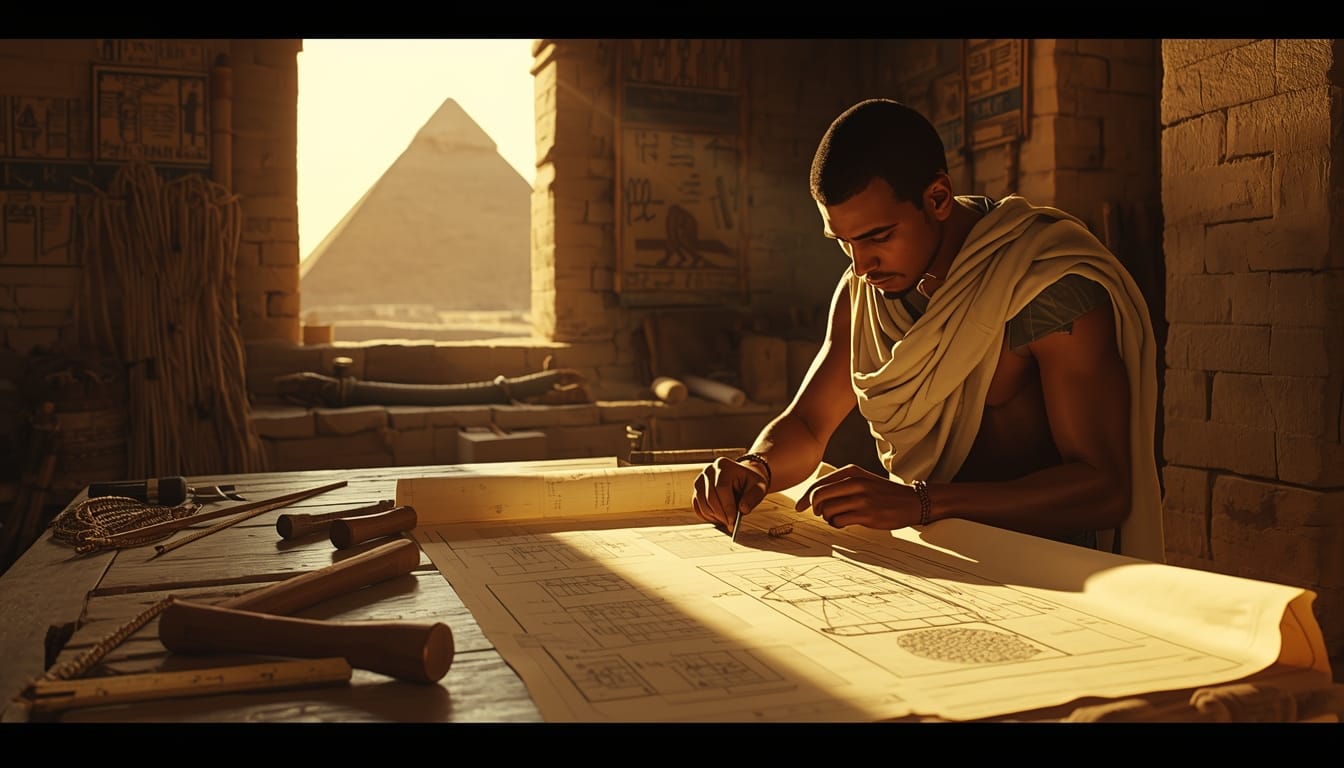
The precision of the Great Pyramid remains an insult to modern engineering. The base is levelled to a margin of error of barely 2 centimetres. Its sides are oriented to the cardinal points with a deviation of only 3 arcminutes (a fraction of a degree). How did they do it without a compass? Using astronomical hardware: the observation of the circumpolar stars and the method of the sun's shadow with a plumb line and a cord.
The angle of inclination, the famous Egyptian seqed, was fixed at 51.9 degrees. A perfect slope that balanced the aesthetics of reaching the heavens with structural stability, avoiding the disaster that Khufu's father, Sneferu, suffered with the Bent Pyramid at Dahshur.
Hemiunu's greatest technical challenge was the King's Chamber, suspended 43 metres up inside the pyramid. To keep millions of tonnes of stone from crushing the sarcophagus, the engineers designed a system of five superimposed "relieving chambers", topped with a gabled roof. The granite beams that form this roof weigh up to 50 tonnes each. Hauling them up the ramps required teams of up to 300 men pulling in unison.
Today, while the white Tura casing has vanished, plundered by later generations to build Cairo, the core of the pyramid still stands. Akhet Khufu is no alien mystery; it is the absolute triumph of administration, logistics and human will. Hemiunu proved that, with enough beer, copper and impeccable planning, the human being is capable of building eternity.
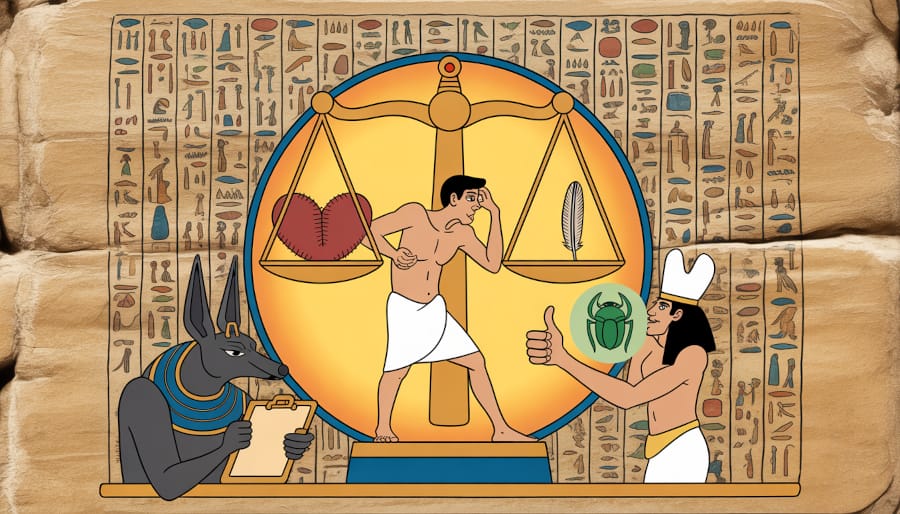
DOES YOUR HEART WEIGH MORE THAN A FEATHER? DON'T RISK IT!
The judgement of Osiris does not accept bribes in copper, but it does accept good legal preparation. If you have been stealing irrigation water or insulting your mother-in-law, you need our Protective Scarab Pack. They void awkward confessions on the scales of Anubis and guarantee you a VIP pass to the Field of Reeds. Don't leave your eternity in the hands of cut-price embalmers!
* Donation to the Pultsar News project



Comentarios ()