
EXCLUSIVE! Bi Sheng opens his workshop to Pultsar: "carving whole woodblocks bored me to tears"
HANGZHOU, SONG EMPIRE, YEAR 1045 A.D. | SIMA SHEN “THE ARCHIVIST” | 🧧 IMPERIAL CHINA · SILK & FIRE INTELLIGENCE
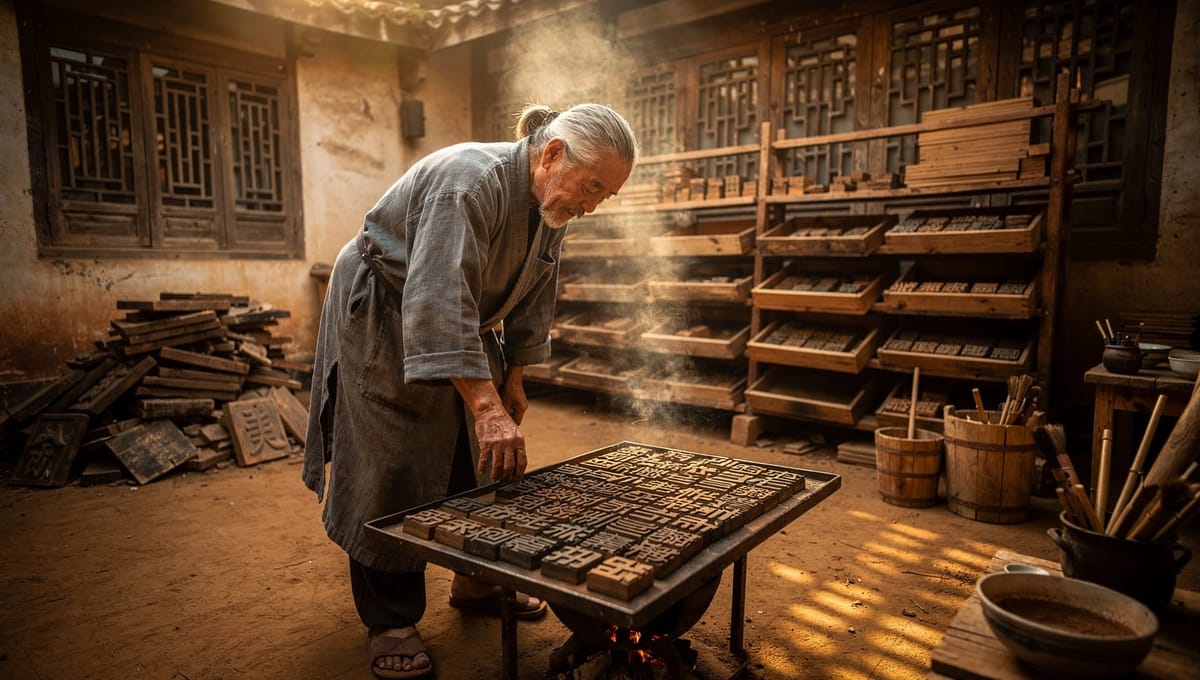
The workshop smells of three things at once: burnt pine, warm wax, and damp clay. It is mid-afternoon in Hangzhou, and Bi Sheng, a local blacksmith of some fifty-five years, is placing a fired-clay character with two fingers onto a hot iron plate. The wax melts, the type settles, and he leaves it there as if he had just planted a tree. “It’s not magic,” he warns us before we can ask anything. “It’s patience and a scrap of paper.”
What Bi Sheng holds in his hands is, according to the chroniclers already beginning to gather in his courtyard, the invention that will change the way China—and, in time, the entire world—produces books. A printing system based on movable type: each character, instead of being carved alongside the rest in one enormous woodblock, lives apart, on a piece of fired clay the size of a thumbnail. To print a page, you select the types you need, set them in a frame with pine wax and ash, fix them with heat, ink them, and press. For the next page, you reheat the frame, the types come loose, and they return to their shelf, sorted by rhyme. The sheet comes out in minutes. The next sheet, too.
Classical woodblock printing—the method we have used for centuries, in which a craftsman carves each whole page into a block of pear or jujube wood—remains the norm in any serious print shop in the Empire. But Bi Sheng, modest, almost shy, holds in his hand what many in this courtyard already consider its successor. We wanted to sit down with him to understand how one arrives here from the forge and, above all, why the court has not yet called on him.
Society: the blacksmith who had enough
Before printing, Bi Sheng was—and remains, as far as the local registry is concerned—a blacksmith. Not a scholar, not an official, not a monk. A craftsman. His family name (毕) ties him to a modest lineage in the county, and according to neighbors in his quarter, his entry into woodblock printing came by commission: someone needed a medical manual reprinted, and Bi Sheng, who had a good hand for carving metal, offered to carve wood. "Once I carved an entire block of the Thousand Character Classic—he tells us, pointing to a stack of old plates in the corner—and when I reviewed it I discovered I had changed one stroke in character number three hundred and twelve. I had to redo the whole block. A week’s work, gone." He makes a gesture with his hand that anyone who has ever deleted an unsaved document would understand at once.
That was the moment, he says, when he began to “dream of loose characters.” It was no flash of genius. It was, quite literally, productive laziness: a tired man looking for a way not to redo a whole week over a single stroke. His wife, according to a neighbor who asked not to be identified, “thought he was losing his mind over those bowls full of clay.” Bi Sheng confirms it. “My wife came close to throwing the whole lot out into the yard. I’m grateful to her,” he adds, laughing quietly. “If she had thrown it out, we wouldn’t be here.”
Engineering: anatomy of an invention made of clay
The invention, coldly considered, has a humble elegance. Bi Sheng describes it to us with the same calm a baker might use to describe a loaf of bread:
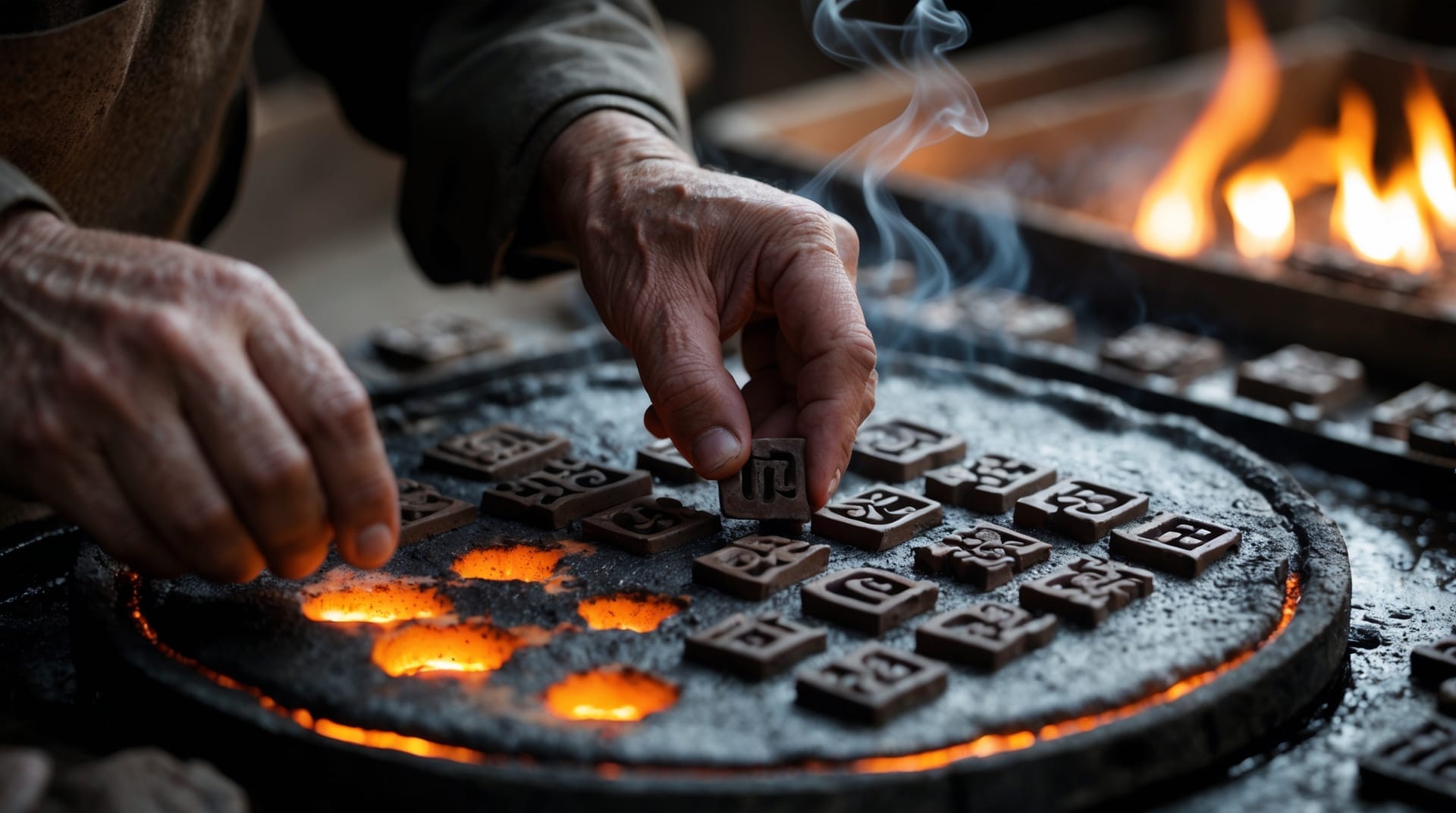
- The types. Each character is modeled on a small piece of damp clay, no taller than a grain of rice. It is fired until it hardens. “Harder than the graphite from the mines, softer than bronze,” he specifies.
- The set. For common characters he makes several duplicates—“of some, like 之 (zhī, the possessive particle), I have twenty.” For the rare ones, just a single copy. He keeps them in wooden trays, sorted by rhyme.
- The base. An iron plate, flat and rectangular, over which a mixture of pine, wax, and paper ash is spread. The plate is heated over the fire: the mixture softens.
- The setting. The types are chosen from the shelf, placed face up on the softened base, and pressed with another flat plate until they are all at the same height. The plate is removed from the fire and the mixture, as it cools, fixes the types in place.
- The printing. Ink is applied, the paper is laid down, the press comes down. The result, on the page, is indistinguishable from a well-made woodblock print.
- The recycling. For the next page, the plate is reheated. The mixture softens. The types come loose, are cleaned, and are returned to the tray. And it starts all over again.
“We work with two plates at a time,” he explains. “While one prints, the other is being composed. By the time the first runs out of ink, the second is already ready. It’s like having two kitchens.”
The subtlety is in the details. Bi Sheng ruled out wood for the types because “it absorbs water from the ink and warps.” He tried types made from wax root, “but when the base was reheated, the types melted too.” Fired clay was his third bet. It worked.
Interview: Bi Sheng, in his workshop

Sima Shen (Pultsar): First things first, the obvious question. Why clay and not metal?
Bi Sheng: Money. Bronze would be ideal—it doesn’t warp, it doesn’t break. But casting a full set of bronze would cost me what I earn in five lifetimes. The clay I take from the river. I fire it in my own kiln.
SS: I see. How long did it take you to compose your first complete book?
BS: The Lotus Sutra, eighteen scrolls. Three months of composition from the first type to the first proof. But the second copy, that very night. The thirtieth, a week. That’s what matters: the first book is always expensive. The thirtieth is almost free.
SS: How much would you need to prepare the complete inventory of types? I mean the thousands upon thousands of characters in the language.
BS: (a long silence) I don’t have the complete inventory. I have about six thousand types. For the most common texts, that’s enough. For a specialized text—a treatise on astronomy, say—I have to carve the rare characters as I go. That, I still haven’t solved.
SS: Has the court taken any interest in your system?
BS: (smiles without much heart) The court has good block carvers. And the good carvers have important surnames. I don’t have an important surname. I’m a blacksmith.
SS: Does it worry you that your invention might die with you?
BS: My nephews know how to make the types. They don’t know how to sell them. We’ll see.
The Gossip: why Hangzhou’s hand isn’t trembling yet
We spoke with three printers in the city—the most senior of them begged us, almost pleading, not to appear in writing by name. The general feeling within the guild is one of restrained respect, mixed with a certain relief. “If this works,” the veteran confesses, “my shop closes. I have sixteen apprentices carving wood all day. Not one of them knows how to compose with loose type.”
There is another resistance, subtler. Woodblock printing is not just a technique: it is a cultural object. When a court official commissions a book, he also commissions the carver’s calligraphy, his stroke, his aesthetic signature. A woodblock book has the hand of a man behind every page. A movable-type book has the hand of Bi Sheng on all of its pages, identical. “It’s cleaner,” admits a buyer from the local academy. “But it’s also colder. The literati want their book to have a soul.”
There is also a prosaic detail that no courtly chronicler will dare put into a memorial: Chinese characters are a great many. While a phonetic alphabet could be composed with two dozen types, Bi Sheng’s language needs several thousand just to get started, and tens of thousands to cover the full body of classical literature. A European bookseller—if Europe existed in the way Hangzhou thinks today of Europe—could set up an entire print shop with a couple of cases of type. Bi Sheng needs a warehouse.
Reflection: how many brilliant inventions die because the culture doesn’t need them yet?
There is a question that, on the way back from the workshop, will not let go of us. Bi Sheng has done, in his Hangzhou courtyard, exactly the same thing that a German goldsmith named Gutenberg will do four hundred years from now. The German, however, will change the world. Bi Sheng, in all likelihood, will not.
Why?
Not because his invention is inferior. It is excellent. The reason is older than any invention: the culture that receives a novelty decides whether it needs it. Song China has formidable block carvers, an administration that already generates more paper than it can read, and an aesthetic taste for unique calligraphy. It does not have a problem that movable type comes to solve. Europe, four centuries from now, will: an explosion of reading demand, a short alphabet, a handful of merchants with money to invest in machines. There, movable type—reinvented, this time in metal—will catch like dry tinder.
Bi Sheng, by contrast, will live in peace. His types will outlive his death; his nephews will inherit them; a historian named Shen Kuo will write down what we are telling here in his Dream Pool Essays, and through that page by a lucid chronicler we will know, four centuries later, that modern printing was not born in Mainz. It was born in Hangzhou. In a blacksmith’s courtyard. Smelling of pine, wax, and clay.
The question we carry away is not whether Bi Sheng will succeed. It is another, far more universal and far more uncomfortable: how many Bi Shengs are we having right now, without knowing it, simply because we have not yet come to have the problem that their invention solves?
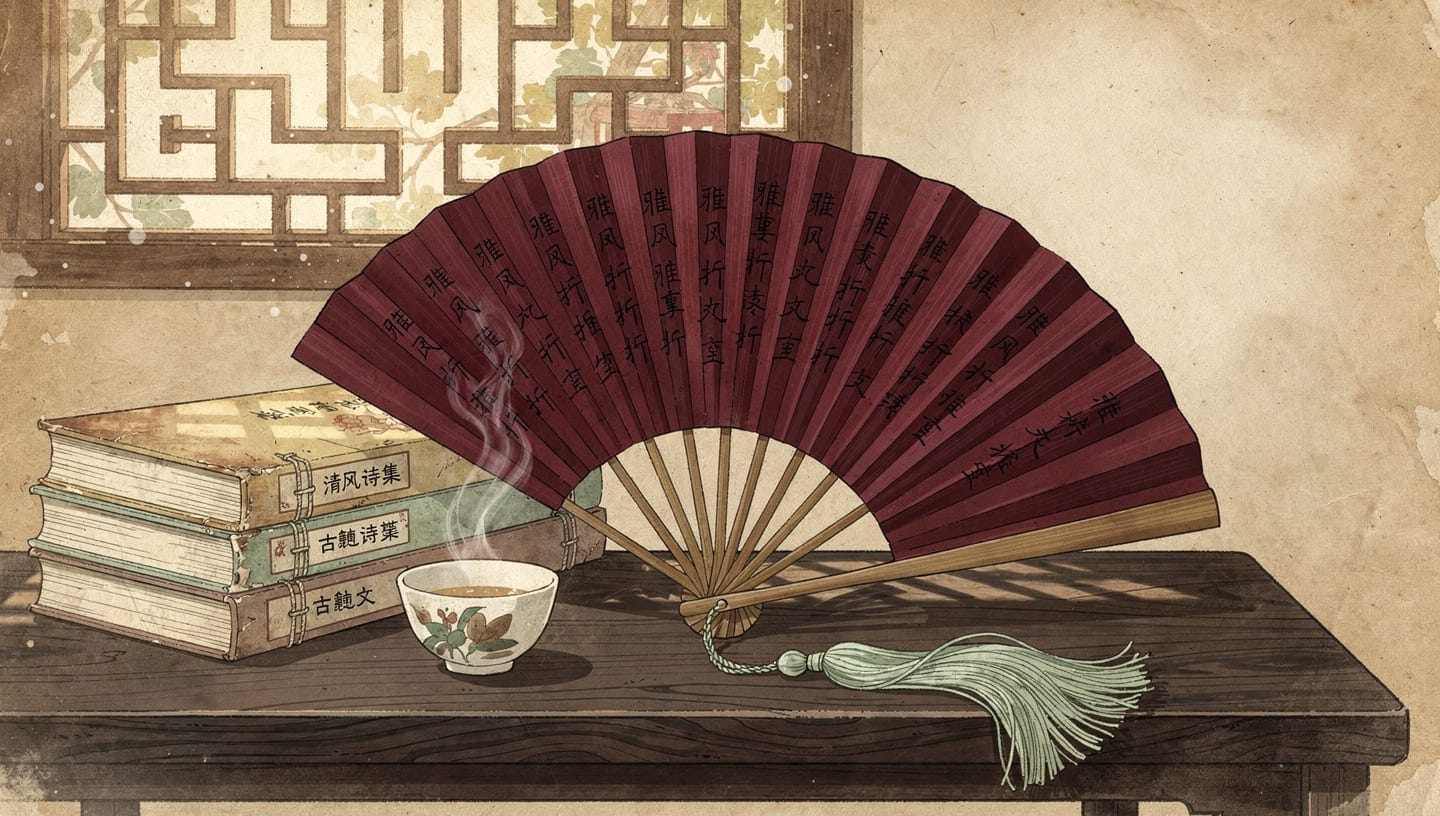
Master Wáng’s fans — lacquered pearwood from the Yangtze
Does your hand still smell of pearwood sawdust after work?
Forged from the wood left over from the neighborhood’s printing blocks. Subtle aroma, a design in six strokes, lacquered bamboo handle, silent ribs. For literati who breathe in their own importance and for officials who need to hide a yawn in the middle of an audience.
* A donation to the Pultsar News project



Comentarios ()